Streamline your retail business with these retail POS software features
Published:
Last Updated:
The retail industry has always been one of the most competitive business landscapes, but over the last few years, the intensity of competition has increased manifold. Customers today are more informed, more demanding, and far less loyal than before. They expect speed, accuracy, convenience, and consistency—whether they are shopping at a physical store, browsing online, or interacting with a brand on social media. In such a fast-evolving environment, technology has become the single most important differentiator for retail success.
At the heart of this technological ecosystem lies Retail POS (Point of Sale) software. Far from being just a billing tool, modern POS software has evolved into the operational nerve center of retail businesses. It connects the storefront to inventory, finance, supply chain, analytics, and customer engagement systems. For retailers and wholesalers managing multiple stores, warehouses, users, and channels, the POS system directly influences efficiency, profitability, and scalability.
To stay competitive, retailers must continuously adapt to newer technologies—and an advanced retail POS software is often the first and most impactful step in this journey. A robust POS solution not only ensures smooth day-to-day operations at the store level but also empowers business owners and managers with actionable insights for smarter decision-making.
However, selecting the right retail point of sales or billing software is not an easy task. The market is crowded with options that promise speed, simplicity, and flexibility. Many systems perform well at basic billing but fall short when it comes to integration, scalability, analytics, and long-term business alignment. Retailers must therefore look beyond surface-level features and evaluate POS software based on how well it supports end-to-end retail operations and future growth.
An ideal retail POS solution should seamlessly handle store operations while feeding accurate, real-time data into a centralized ERP and analytics system. It should be flexible enough to support different business models—retail, wholesale, franchise, omnichannel—and powerful enough to grow with the business.
Outlined below are the essential features that a modern retail POS software must have, elaborated in detail and aligned with today's retail realities.

See how Ginesys One brings all your retail operations together
Accurate Reporting
Understanding what is happening at the retail store—down to the smallest detail—is fundamental to running a successful business. Every transaction, return, discount, and payment method generates data. When captured and analyzed correctly, this data becomes one of the most valuable business assets for any retailer.
Accurate reporting is no longer limited to daily sales summaries or end-of-month revenue figures. Today's retailers need real-time, granular, and actionable insights that help them understand customer behavior, product performance, staff efficiency, and store-level profitability.
A modern retail billing software should provide detailed transaction-level reporting that enables retailers to:
- Track sales by product, category, brand, and SKU
- Analyze peak sales hours and customer footfall patterns
- Monitor discounts, returns, and cancellations
- Compare performance across stores, regions, or channels
Such insights play a crucial role in understanding consumer buying behavior. For example, identifying frequently purchased product combinations can help improve product placement and bundling strategies. Recognizing slow-moving inventory early can help retailers take corrective action through targeted promotions or stock redistribution.
Accurate POS reporting also helps uncover operational loopholes at the store level. Variances in cash reconciliation, unusually high return rates, or inconsistent discounting patterns can all indicate underlying process or training issues. With reliable data, retailers can address these problems proactively rather than reactively.
Another critical area where accurate reporting adds value is assortment planning. Historical POS data enables retailers to identify which products perform well in specific locations, seasons, or customer segments. This allows smarter buying decisions and reduces the risk of overstocking or stockouts.
While the original focus of POS reporting was often limited to billing data, modern systems integrate POS data with ERP, BI, and analytics platforms. Within the Ginesys One ecosystem, POS data flows seamlessly into Ginesys ERP, Ginesys BI, and InsightX, enabling retailers to move from raw transaction data to advanced dashboards and predictive insights.
Although Ginesys does not provide a native loyalty program, its POS and ERP systems integrate seamlessly with third-party loyalty partners. Accurate reporting from POS systems plays a critical role in designing and managing effective loyalty initiatives by ensuring customer purchase data is reliable, timely, and actionable.
In today's retail environment, accurate reporting is not just about visibility—it is about control, foresight, and competitive advantage.

Stop guessing and start deciding with data. See how Ginesys BI and InsightX turn your POS transaction data into powerful dashboards and predictive insights
Integrated Workflows and Functions
Retail operations are inherently complex. A single sale at the POS counter impacts inventory levels, financial records, taxation, vendor replenishment, and sometimes even inter-store transfers. When these processes are managed through disconnected systems, inefficiencies and errors become inevitable.
One of the most important features of a good retail POS software is its ability to support integrated workflows and functions. The POS system should not operate in isolation—it must be deeply connected with inventory management, procurement, finance, compliance, and fulfillment systems.
At a minimum, a modern POS solution should seamlessly integrate:
- Point of Sale operations
- Inventory management (store and warehouse level)
- Pricing and promotions
- Vendor and purchase management
- Returns and exchanges
- Taxation and compliance
When workflows are integrated, data flows automatically across systems without manual intervention. This eliminates duplicate data entry, reduces errors, and saves significant time for store staff and back-office teams.
For instance, when a product is sold at the POS:
- Inventory should be updated in real time
- Financial entries should be posted automatically
- Replenishment triggers should be generated if stock falls below threshold
In many retail businesses, POS and inventory are considered the heart of the system. However, true operational efficiency is achieved only when vendor information, purchase orders, fulfillment schedules, and warehouse movements are also managed within the same ecosystem.
This is where integrated retail management platforms like Ginesys One stand out. Ginesys POS and Zwing POS integrate tightly with Ginesys ERP, enabling retailers to manage everything from store billing to backend operations on a single, unified platform. For omnichannel retailers, Browntape (Ginesys OMS) further extends this integration by connecting online orders, marketplaces, and warehouses with store-level POS systems.
Integrated workflows become even more critical as businesses scale. Multi-store and multi-warehouse retailers cannot afford fragmented systems that require constant reconciliation. A POS software with strong integration capabilities becomes a foundation for scalable growth.
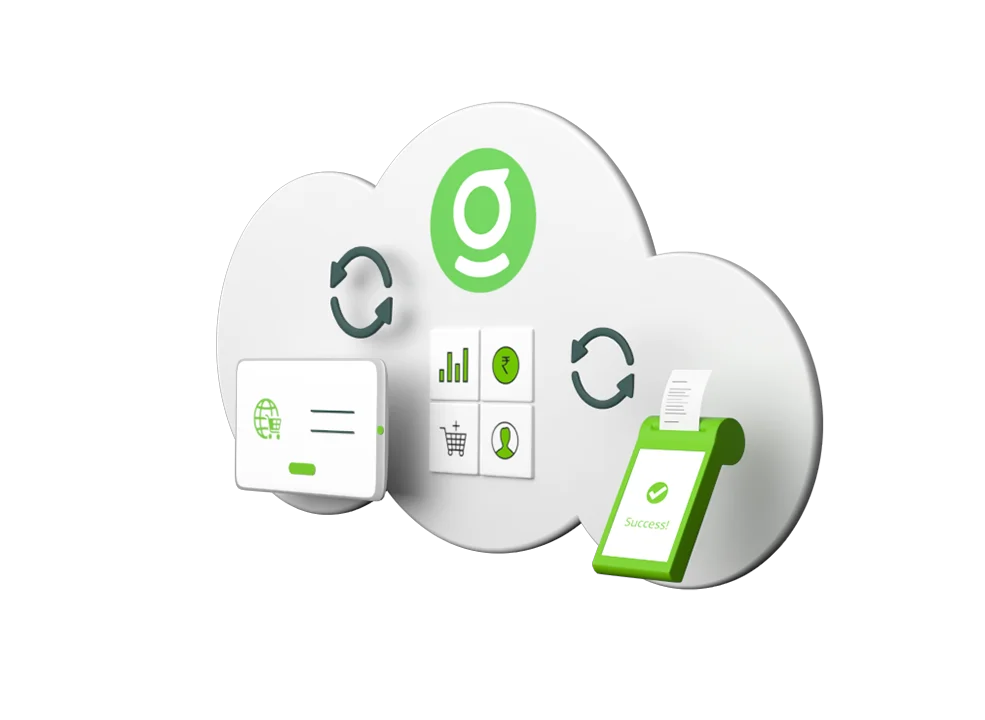
From POS to ERP to OMS — discover how Ginesys One connects every part of your retail business.
Fast and Easy Billing
Speed at the checkout counter is one of the most visible and impactful aspects of customer experience in a physical store. No matter how attractive the store layout or how helpful the staff, long queues and slow billing can instantly frustrate customers and negatively impact brand perception.
Today's customers value convenience above almost everything else. They expect billing to be fast, smooth, and error-free. A good retail POS software must therefore be optimized for high transaction volumes and peak-hour footfall.
Fast and easy billing depends on several factors:
- Intuitive user interface for billing staff
- Quick product lookup through barcode scanning or search
- Minimal steps to complete a transaction
- Support for multiple payment modes
Modern POS systems must handle cash, cards, UPI, wallets, gift vouchers, and mixed payments seamlessly. Any lag or complexity during payment processing directly affects throughput and customer satisfaction.
Ease of billing is equally important for store staff. A cluttered or unintuitive POS interface increases training time and the likelihood of errors. In contrast, a well-designed POS system enables new staff to become productive quickly and reduces dependency on highly skilled operators.
Mobile POS (mPOS) has further transformed billing experiences. Solutions like Zwing POS enable retailers to convert mobile devices into billing counters, allowing staff to complete transactions anywhere on the shop floor. This not only reduces queues but also creates a more personalized and flexible shopping experience.
Fast billing does more than improve customer experience—it also enhances operational efficiency. Higher billing throughput means more customers served per hour, better utilization of store space, and increased revenue potential during peak periods.

Experience faster checkouts with Zwing POS on any device.
Scalability and Multi-Store Readiness
While not explicitly highlighted in earlier retail discussions, scalability has become a non-negotiable requirement for POS software today. Retailers rarely remain static; they add new stores, warehouses, channels, and users as the business grows.
A POS system designed only for single-store operations quickly becomes a bottleneck when expansion begins. Modern retail POS software must be multi-store and multi-user ready by design.
Scalable POS systems allow retailers to:
- Manage pricing and promotions centrally
- Monitor performance across locations in real time
- Maintain consistent customer experience across stores
- Add new stores with minimal configuration effort
Within the Ginesys ecosystem, scalability is a core strength. Whether a retailer operates five stores or five hundred, Ginesys POS and ERP support centralized control with decentralized execution. Cloud-based deployment further simplifies expansion by eliminating local infrastructure dependencies.
Cloud Readiness and Easy Upgradation
In 2017, cloud-based POS systems were still gaining acceptance. Today, cloud readiness is a fundamental expectation. Retailers increasingly prefer cloud-based solutions for their flexibility, reliability, and ease of maintenance.
Cloud-enabled POS software offers several advantages:
- Faster deployment and onboarding
- Automatic software updates
- Lower IT infrastructure costs
- Remote access to data and reports
With Ginesys Cloud ERP and POS, retailers no longer need to worry about manual upgrades or version mismatches. Enhancements, security updates, and statutory changes are rolled out seamlessly, ensuring that businesses always operate on the latest, most secure platform.
Cloud readiness also supports business continuity. POS systems continue to function even during connectivity issues and sync automatically once the connection is restored—ensuring uninterrupted billing.
Analytics-Driven Decision Making
Retail success today is driven by data-backed decisions rather than intuition. A modern POS system should not just capture data—it should enable analysis and insight generation.
Advanced POS solutions integrate with BI and analytics platforms to provide dashboards, KPIs, and trend analysis. Ginesys BI and InsightX transform POS and ERP data into meaningful insights, helping retailers understand what is working, what is not, and where to focus next.
From store managers to CXOs, analytics-driven POS systems empower every stakeholder to make smarter, faster decisions.
Retail POS software has evolved from a simple billing tool into a strategic enabler of retail excellence. In a highly competitive and fast-changing market, retailers can no longer afford outdated or fragmented systems.
A good POS system—when combined with integrated ERP, OMS, BI, and cloud capabilities—creates a robust retail management ecosystem. Solutions like Ginesys One, encompassing Ginesys POS, Zwing POS, ERP, OMS, BI, and InsightX, empower retailers and wholesalers to streamline operations, enhance customer experience, and scale confidently.
In the modern retail landscape, the right POS software is not just a technology investment—it is a business transformation catalyst.
Frequently Asked Questions (FAQs)
1. Why is POS software critical for retail businesses today?
POS software is the operational backbone that connects sales, inventory, finance, and analytics, enabling efficiency and growth.
2. Is POS software only for billing?
No. Modern POS systems manage inventory, reporting, integrations, analytics, and customer experience.
3. Can Ginesys POS support multiple stores and users?
Yes. Ginesys POS and Zwing POS are designed for multi-store, multi-user retail and wholesale businesses.
4. Does Ginesys POS work with ERP?
Yes. Ginesys POS integrates seamlessly with Ginesys ERP under the Ginesys One suite.
5. Is cloud-based POS better than on-premise?
Cloud-based POS offers easier upgrades, scalability, lower IT overhead, and better reliability.