Mandatory Ship-To GSTIN in E-Way Bills from 1 August 2026: What Businesses Need to Know
Published:
Last Updated:
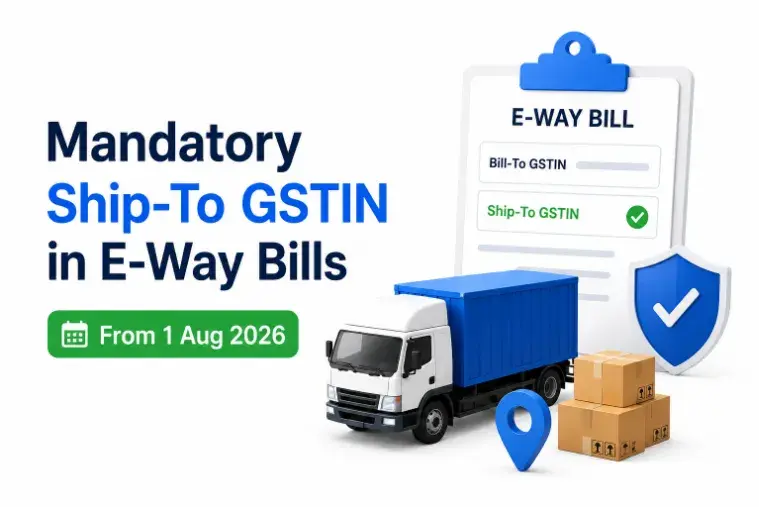
From 1 August 2026, an important update is being introduced in the E-Way Bill system under GST compliance. Under India's GST framework, businesses generating E-Way Bills will now need to capture mandatory Ship-To GSTIN details in applicable transactions where goods are delivered to a location or entity different from the billing party.
As per GSTN Advisory No. 664 dated 17 June 2026, the Ship-To GSTIN mandate is effective from 1 August 2026 in both the e-Invoice and E-Way Bill APIs.
At first, this may appear like a small compliance change. But for businesses handling large shipment volumes, branch transfers, third-party logistics, or multi-location deliveries, this update can directly affect everyday dispatch operations.
Many companies currently focus only on invoice generation, transporter details, and dispatch timelines while creating E-Way Bills. With this latest requirement, businesses will also need to ensure that the delivery GSTIN details are accurate and properly linked to the actual shipment destination.
For organizations already dealing with invoice mismatches, E-Way Bill errors, or manual compliance challenges, this update makes process accuracy even more important.
The objective behind this change is to improve transparency in the movement of goods. GST authorities are strengthening transaction tracking to reduce incorrect reporting, fake billing activities, and mismatched movement records. As compliance systems become more data-driven, businesses will need stronger operational coordination to avoid errors.
Key Takeaways
- Effective 1 August 2026, Ship-To GSTIN is mandatory for all Bill-To/Ship-To E-Way Bill transactions
- Applies to B2B and SEZ transactions; export transactions are excluded
- For unregistered consignees, enter "URP" in the Ship-To GSTIN field
- Missing or incorrect GSTIN will block E-Way Bill generation entirely
- Penalty under Section 129 CGST Act: 200% of taxes payable for non-compliance
Reduce E-Way Bill errors with automation. Ensure accurate GST validation and faster compliance with GinesysOne.
What is the Ship-To GSTIN Requirement in E-Way Bills?
A Bill-To/Ship-To transaction is one where the entity being invoiced differs from the entity receiving the goods. From 1 August 2026, GSTN requires the GSTIN of the actual consignee to be mandatorily entered in the Ship-To GSTIN field of the E-Way Bill for all such transactions.
In many industries, the billing address and delivery location are often different.
A supplier may raise an invoice to a company's head office while shipping goods directly to a warehouse, branch office, distributor location, or franchise outlet. Ecommerce and retail businesses regularly handle such transactions across multiple cities and states.
Until now, businesses mainly concentrated on invoice details and transporter information while generating E-Way Bills. Starting from August 2026, Ship-To GSTIN information will become another important compliance checkpoint.
If the Ship-To details are incorrect, incomplete, or mismatched with invoice records, businesses may face operational issues during transportation checks or GST verification procedures.
This means E-Way Bill generation can no longer remain just a dispatch activity. It now becomes more closely connected with shipment validation and delivery accuracy.
Operational Accuracy Will Become More Important
Most businesses today are aware of basic GST compliance rules. The bigger challenge is usually not knowledge but execution.
Different departments handle different parts of the process. The finance team creates invoices, warehouse teams prepare dispatches, transporters manage delivery movement, and logistics teams coordinate shipments. When information flows manually between these departments, small errors become common.
A single incorrect GSTIN entry may look minor internally, but during transit verification, it can create serious compliance concerns. If invoice information, delivery location details, and E-Way Bill records do not match properly, shipments may get delayed or questioned.
This becomes more difficult during high-volume periods when teams are already working under pressure to complete dispatches quickly.
As businesses scale operations, accuracy in documentation becomes just as important as delivery speed.
Why Manual Data Entry May Increase Compliance Risks
Many businesses still depend heavily on manual processes while generating E-Way Bills.
Teams often copy information from invoices, emails, or spreadsheets and manually upload details into the portal. Even experienced staff members can make mistakes when shipment volumes are high or timelines are tight.
With Ship-To GSTIN becoming mandatory, another important layer of information is now added to the process. This naturally increases the chances of mismatches if businesses continue relying entirely on manual workflows.
Some common issues businesses may face include:
- Incorrect GSTIN mapping
- Wrong delivery location selection
- Duplicate shipment entries
- Branch-level dispatch mismatches
- Delays caused by correction requests
These risks become larger for companies operating through multiple warehouses, distributors, or regional fulfillment centers.
For businesses processing hundreds of shipments daily, manual validation alone may no longer be enough.
Industries Likely to Experience Higher Impact
The impact of this compliance change will vary across industries.
Businesses with simple local delivery operations may not face major challenges initially. However, companies with complex supply chains and multi-location dispatch operations are likely to experience greater operational impact.
This is especially relevant for industries such as retail, ecommerce, fashion, FMCG distribution, manufacturing, electronics, and logistics services.
These sectors often handle transactions where billing entities and delivery destinations differ frequently. A distributor may order stock centrally while deliveries happen directly to individual retail stores or franchise locations.
In such environments, even a small mismatch in delivery GSTIN details can affect multiple shipments in a short period.
That is why many organizations are already reviewing their invoicing and logistics processes ahead of the August 2026 deadline.

Managing multi-location dispatches? Simplify GST compliance with a unified ERP built for growing businesses.
Shipment Delays Can Become a Bigger Concern Than Penalties
When businesses think about GST compliance issues, they usually focus on penalties first.
But in reality, operational disruptions often create bigger business problems.
If shipments are held during transit due to incorrect or mismatched Ship-To details, deliveries get delayed. Customers may not receive stock on time, warehouse schedules get disrupted, and inventory planning becomes difficult.
Repeated mismatches can also increase scrutiny from GST authorities, leading to additional verification requests and operational pressure on compliance teams.
For growing businesses, these disruptions can affect customer relationships and supply chain efficiency much more than financial penalties alone.
This is why businesses are now paying closer attention to operational compliance accuracy instead of treating GST requirements as only a finance-related responsibility.
Better Coordination Between Teams Will Be Necessary
One of the most important changes businesses will need is stronger coordination between departments.
GST compliance today is no longer managed only by the accounts team. Warehouse operations, dispatch management, logistics coordination, and billing systems all contribute to the accuracy of E-Way Bill generation.
If one department updates shipment information but another team continues using old records, mismatches become unavoidable.
Businesses will need to ensure that all departments work with synchronized and updated data.
Even simple process improvements can reduce the chances of errors significantly. Clear communication between billing, warehouse, and logistics teams will become increasingly important as compliance validation becomes stricter.
How Integrated Systems Reduce E-Way Bill Errors
As GST compliance becomes more detailed, businesses are realizing that disconnected systems create unnecessary operational risks.
What worked earlier for smaller operations may not be sustainable once shipment volumes increase across locations and channels.
Companies now need systems that can connect:
- Billing and invoicing
- E-Way Bill generation
- Inventory movement
- Logistics tracking
- GST compliance workflows
- Warehouse operations
When these functions are connected through a single system, information flows automatically instead of being entered repeatedly across different platforms.
This reduces manual dependency and improves overall accuracy.
Businesses also gain better visibility into shipment status, delivery records, and compliance reporting, which helps reduce operational confusion.

One platform. Smarter GST compliance. Connect billing, inventory, and E-Way Bills with GinesysOne.
Preparing Early Can Reduce Future Disruptions
Many organizations wait until the final implementation stage before adjusting their processes for compliance updates.
That approach often creates avoidable operational issues later.
When new rules become mandatory, businesses suddenly rush to train teams, update software systems, and correct workflow gaps at the same time. This increases the chances of mistakes during the transition phase.
Preparing earlier gives businesses enough time to review their existing processes properly.
Companies should begin evaluating whether their current billing and dispatch systems can handle Ship-To GSTIN validation accurately. They should also check whether delivery information flows consistently across departments without manual duplication.
Identifying operational gaps now can help businesses avoid larger disruptions after implementation begins.

Get ready before 1 August 2026. Future-proof your GST workflows with GinesysOne.
Steps to Prepare for Ship-To GSTIN Mandate
- Validate Ship-To GSTINs in your database - Use the GST portal's Search Taxpayer tool to confirm each delivery location's GSTIN is active and state-matched.
- Update ERP or billing software - Confirm with your vendor that the Ship-To GSTIN field is mandatory in the EWB generation flow.
- Enter URP for unregistered consignees - Where the delivery location has no GSTIN, "URP" is the required entry; blank fields will fail validation.
- Train dispatch and warehouse teams - Staff generating E-Way Bills manually need to know how to identify Bill-To/Ship-To transactions and what to enter.
- Test API integrations - If your business uses ERP or direct API integration, run end-to-end tests in the GSTN sandbox before go-live.
Compliance Is Becoming More Operationally Connected
GST compliance is steadily moving toward deeper digital validation and transaction-level visibility.
Authorities increasingly rely on invoice matching, E-Way Bill verification, and shipment tracking to monitor business activity more accurately. Because of this, compliance can no longer function as a separate back-office task disconnected from operations.
Today, operational efficiency and compliance accuracy are becoming closely linked.
A shipment delay caused by documentation mismatches can affect customer satisfaction, inventory availability, and even future sales planning. This is why businesses are gradually shifting toward more integrated operational models instead of handling compliance separately.
The mandatory Ship-To GSTIN requirement is another step in that direction.
It encourages businesses to improve process visibility, reduce manual errors, and create stronger coordination between operational functions.
Conclusion
The mandatory Ship-To GSTIN update effective from 1 August 2026 is more than just another GST compliance requirement. It directly affects how businesses manage shipment accuracy, delivery validation, and operational coordination.
For businesses handling large dispatch volumes, multiple delivery locations, or complex supply chains, this change makes process accuracy more important than ever.
Organizations continuing to depend heavily on manual workflows may face higher risks of mismatches, shipment delays, and compliance-related disruptions. On the other hand, businesses using integrated systems and connected workflows will be better prepared to manage these changes smoothly.
As GST regulations continue evolving, businesses are increasingly moving toward platforms that connect billing, inventory, logistics, and compliance operations together.
Solutions like GinesysOne help businesses streamline GST-related workflows by reducing manual effort, improving data accuracy, and supporting more efficient E-Way Bill management across multiple operational processes.

Stay compliant. Keep shipments moving. Automate GST workflows and E-Way Bill generation with GinesysOne.
Frequently Asked Questions (FAQs)
1. What is the Ship-To GSTIN requirement in E-Way Bills from August 2026?
From 1 August 2026, businesses generating E-Way Bills for Bill-To/Ship-To transactions must mandatorily enter the GSTIN of the actual consignee, the party receiving the goods in the Ship-To GSTIN field. This requirement aims to improve traceability of goods movement and ensure greater accuracy in GST compliance.
2. Which transactions are considered Bill-To/Ship-To under E-Way Bill rules?
The change applies to Bill-To/Ship-To transactions where the buyer and the consignee are different parties, including direct deliveries to customers, branch offices, warehouses, project sites, or any scenario where goods are delivered to a location different from the entity being invoiced.
3. What should I enter in the Ship-To GSTIN field if the consignee is unregistered?
If the delivery is to an unregistered site, warehouse, or end consumer, enter "URP" (Unregistered Person). The portal accepts "URP" as a valid entry. Leaving the field blank will cause E-Way Bill generation to fail after 1 August 2026.
4. What happens if the Ship-To GSTIN is incorrect or missing after 1 August 2026?
As of 1 August 2026, no E-Way Bill will be generated in the case of missing Ship-To GSTIN for a Bill-To/Ship-To transaction. Moving goods without a valid E-Way Bill is a contravention of the CGST Rules, and Section 129 of the CGST Act applies, detention, seizure, and a penalty of 200% on taxes payable.
5. Can the Ship-To details be changed after the IRN is generated?
For B2B and SEZ transactions, Ship-to details provided during IRN generation cannot be altered during E-Way Bill generation through the IRN route. For export transactions, GSTN has allowed greater flexibility in modifying Ship-To details at the E-Way Bill stage.
6. Does this requirement apply to export transactions?
Export transactions are excluded from the stricter Ship-To GSTIN controls applied to B2B and SEZ transactions. For exports, GSTN has provided flexibility, and where no domestic registered Ship-To GSTIN exists, "URP" may be used.
7. Why was the August 2026 deadline postponed from June 2026?
The GSTN extended the implementation timeline after receiving representations from trade bodies, industry associations, GSP providers, ERP vendors, and taxpayers who needed more time for system modifications and testing. The revised effective date is 1 August 2026.
8. How should businesses prepare their ERP systems for this change?
Businesses should update customer data, validate Ship-To GSTINs, adjust invoicing workflows, and collect accurate delivery registration details from buyers. ERP users should confirm with their software vendor that the Ship-To GSTIN field is made mandatory in the EWB generation flow before 1 August 2026.