Garment Retail Software: From Production to Point of Sale, One Suite
Published:
Last Updated:
Here is a situation most garment businesses know well. The production team finishes a batch of kurtas two weeks behind schedule. Nobody told the retail buying team. They had already placed a repeat order assuming the first batch was ready. Now there are too many units coming in, the warehouse is short on space, and a bestselling style from the same collection is out of stock in three stores because the allocation was based on numbers that turned out to be wrong.
This is not a people problem. This is a systems problem.
In short: Garment retail software is a single platform that connects production, procurement, warehouse management, inventory, POS, and omnichannel sales for apparel businesses, replacing the disconnected spreadsheets and point systems that cause overbuying, stockouts, and reconciliation delays.

Unify production, inventory, warehousing, and retail with one platform built for garment brands.
The Gap Between Production and Retail in Garment Businesses
Most garment businesses run production and retail on separate systems. Sometimes those systems are connected through an integration, sometimes through a shared spreadsheet, and sometimes through a weekly call between the production head and the buying manager. None of these approaches scale cleanly.
The data produced on the factory floor, how much fabric was consumed, which styles completed quality checks, how many units are ready to ship, does not flow automatically into retail planning. Buying teams make decisions based on expected production quantities rather than confirmed ones. The gap between those two numbers is where overbuying and stockouts both originate.
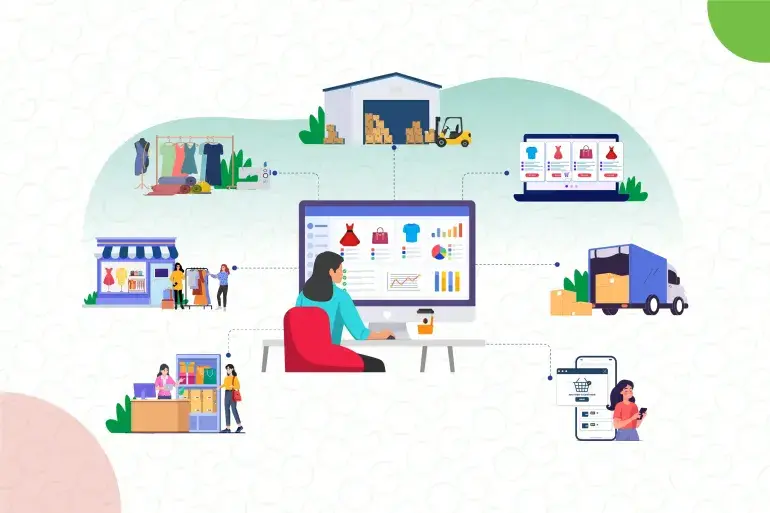
A single suite fixes this at the source. When production data and retail planning sit inside the same garment ERP software, confirmed quantities feed buying decisions in real time. There is no lag, no manual update, and no weekly call to verify numbers that should already be visible.
Production Planning and Procurement
Before a unit reaches the warehouse, a lot has already happened. Styles were selected at the design stage. Fabric requirements were estimated. Suppliers were contacted. Purchase orders were raised. Job workers received instructions.
Each of these steps generates data that the next step depends on. When that data lives in a disconnected system or a shared drive, the chain breaks every time someone has to manually transfer information from one place to another.
Inside a unified suite, collection planning and merchandise planning link directly to buying targets, helping teams plan assortments, allocate inventory, and optimize product availability across stores and channels. Raw material procurement tracks against confirmed production schedules rather than projections. Vendor performance, lead times, and costs are visible in the same place as the purchase orders they relate to. And when production completes a batch, the warehouse team knows it is coming before it arrives, not when the truck pulls up.

Plan smarter from sourcing to production with a retail ERP built for garment brands.
Warehouse Management and Inventory Tracking
Goods arrive at the warehouse. What happens next determines how accurately the entire retail operation functions.
Inbound receiving in a proper garment retail system means verifying quantities against purchase orders at the style, colour, and size level. Not just checking that 500 units arrived, but confirming that the right 500 units arrived, in the right breakdown. Discrepancies caught at inbound are easy to resolve. Discrepancies discovered three weeks later, when a customer is standing at a counter asking for a size that the system says is available, are not.
Barcode management at the unit level makes the rest of this work. Picking accuracy goes up. Packing errors come down. Dispatch records match what actually left the building. When every unit carries a barcode scanned at each stage, the warehouse stops being a black box and starts being a reliable inventory source. This is core to effective apparel warehouse management, since size-colour-style variants make manual stock counts unreliable at any real scale.
Transfers from warehouse to stores work on the same logic. Allocation plans determine which store gets how much, based on sales data and location-level demand. The stock leaves the warehouse, the system updates immediately, and the store can see it coming before it arrives.
Retail POS and Store Operations
A billing counter is not just where money changes hands. It is where the accuracy of everything upstream either holds or falls apart.
If the retail POS software reflects real-time central inventory, store staff can answer a customer's availability question accurately. They can check whether a size not on the floor is available at another store. They can process a return and put that unit back into sellable inventory within minutes. If the POS is running on a delayed sync or a locally cached inventory file, none of this is reliable.
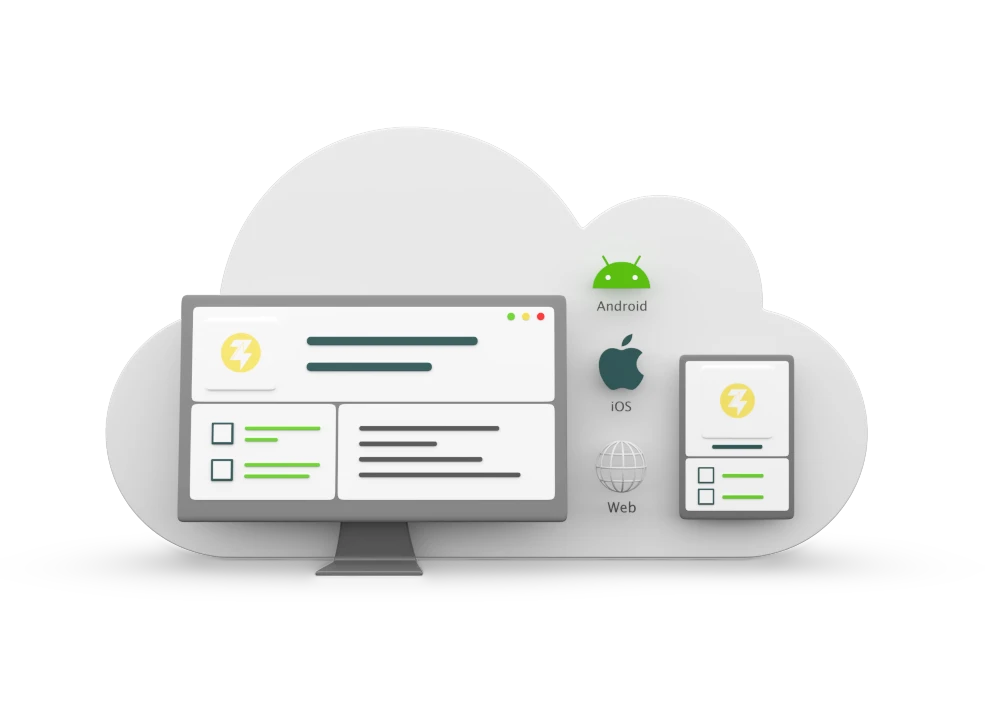
Complex promotions, loyalty programs, and multi-tender transactions are normal in Indian fashion retail, especially during sale periods. The garment POS software needs to handle all of this without slowing down the queue, whether that's a store running Ginesys Desktop POS, a lighter counter on Cloud POS (Zwing), or staff checking stock on Mobile POS. And every transaction, every return, every exchange, needs to feed back into the same system being used by the warehouse team and the buying team making decisions for next season.
Deliver faster checkouts, accurate stock visibility, and seamless store operations.
Marketplace Integration and Omnichannel Selling
A garment brand selling on Myntra, AJIO, Flipkart, and its own website alongside physical stores is not running five operations. It should be running one, with five customer touchpoints.
When each channel maintains its own inventory allocation, overselling is a matter of when, not if. Two orders arrive simultaneously for the last available unit, one from a marketplace and one from the website, and neither channel knew the other was about to sell it. This is a direct result of fragmented inventory, and it happens constantly during peak periods.
A unified system exposes one inventory pool to every channel simultaneously through marketplace integrations and a connected e-commerce OMS. When a unit sells anywhere, it is gone everywhere, immediately. Order routing sends each order to the warehouse or store best placed to fulfil it based on stock availability and delivery timelines. Pricing and promotions apply centrally so a discount running in-store also reflects online without a separate update. This is what proper omnichannel garment retail looks like in practice, one inventory record, not five reconciled ones.
Eliminating Disconnected Systems and the Cost of Fragmentation
Every system a garment business runs as a standalone adds a sync dependency. A production system here, a retail ERP for garment industry there, a separate POS at the store, a marketplace integration tool sitting between all of them. Each one has to agree with the others for the inventory count to be accurate. They rarely do, fully, at any given moment.
The reconciliation that follows consumes real team time every week. Someone pulls numbers from one system, cross-references another, and builds a report that takes three hours to produce and is already partially outdated by the time it reaches a decision-maker.
One integrated platform creates a single source of truth for production, procurement, warehouse, retail, and marketplace operations. Production, procurement, warehouse, retail, and marketplace all update the same record. Reports pull from one place. Decisions get made faster because the information is already assembled.
Benefits of a Unified Suite for Garment Brands
Visibility across the full chain changes how leadership operates. By replacing disconnected systems with a unified retail platform, garment brands can accelerate their digital transformation while improving operational efficiency and decision-making. A buying manager who can see confirmed production quantities, warehouse stock levels, and store sell-through in one view makes different decisions than one working from three separate reports.
Scalability also shifts when integration debt stops accumulating. Adding a new store, a new marketplace, or a second warehouse should not require a new integration project each time. A unified platform absorbs that growth without needing new connectors to keep everything talking to each other.
And when something goes wrong, which it does in any retail operation, there is one implementation partner to call, not three vendors explaining why it is someone else's system causing the problem.
Business reporting is equally important for garment brands. With InsightX by Ginesys, retailers can track sales, inventory, production, and fulfilment through real-time dashboards. Retail-specific insights such as sell-through, stock ageing, inventory turnover, and category performance help teams make faster, data-driven decisions.
How Ginesys Delivers End-to-End for Garment Brands
Ginesys One is purpose-built for fashion and garment businesses, bringing together procurement, production, warehouse management, ERP, POS, OMS, inventory management, and omnichannel commerce on a unified retail platform. Over 1000 fashion and lifestyle brands in India use it, including garment manufacturers who have expanded into retail and multi-store apparel brands managing both production and distribution.
For brands operating across wholesale, retail, and digital channels, including those running fashion distribution to dealers and franchise partners, the platform is built around the specific complexity of the Indian garment business. Implementation follows a phased rollout so operations stay intact through the transition.
If your production and retail teams are still working from different data, a demo is the clearest way to see what one connected system actually looks like in practice.

See how Ginesys One helps garment brands streamline production, procurement, warehousing, retail, and omnichannel commerce from a single platform.
FAQs
What is garment retail software and who needs it?
Garment retail software manages the operations of an apparel business across production, warehousing, store retail, and digital channels in one system. It is most relevant for brands that both manufacture and sell, or those running multiple retail stores and online channels simultaneously.
How does production planning connect to retail buying in a unified suite?
Confirmed production quantities flow directly into the buying team's planning view, so purchase decisions are based on what is actually coming rather than what was scheduled. This reduces overbuy and cuts the stockouts that happen when buying targets were built on estimates that didn't hold.
Can one software handle both garment manufacturing and retail store operations?
Yes, and for brands doing both, it is worth prioritising. A unified system removes the manual data transfer that happens when production and retail run separately, which is where most inventory inaccuracies start.
How does barcode management work across warehouse and POS in garment retail?
Each unit carries a barcode scanned at inbound receiving, putaway, picking, packing, dispatch, and again at the point of sale. Every scan updates the same inventory record, so the count is accurate at every stage without a separate reconciliation process.
What is the difference between a garment ERP and a general retail ERP?
A garment ERP carries the style-colour-size inventory structure natively and supports production planning, merchandise buying cycles, and seasonal collection management. A general retail ERP handles flat SKUs and usually requires heavy customisation before it reflects how apparel inventory is actually structured.
How long does implementation take for a garment brand with both production and retail operations?
Implementation timelines vary depending on the number of stores, existing systems, data migration, and integration requirements. A phased rollout helps ensure a smooth transition with minimal disruption to business operations.