Top E-Way Bill Mistakes That Can Trigger GST Penalties
Published:
Last Updated:
Quick Fact: Thousands of GST notices every year are linked to documentation mismatches, expired e-way bills, invoice inconsistencies, and transport-related compliance issues.
In India, GST compliance is becoming a standard aspect of operating a business. However, e-way bills are one area where even minor errors can lead to major issues among all the compliance chores that organizations deal with.
Vehicle detention, fines, delayed deliveries, and needless stress during transit inspections can result from a missing detail, an outdated e-way bill, or a discrepancy in invoice information.
These errors are not deliberate for many businesses. They typically result from manual labor, inadequate team collaboration, or last-minute dispatch pressure. However, even small non-compliance can draw attention under GST regulations.
What is an E-Way Bill?
An E-Way Bill is an electronic document required for the movement of goods exceeding the prescribed threshold value under GST regulations.
It contains details such as:
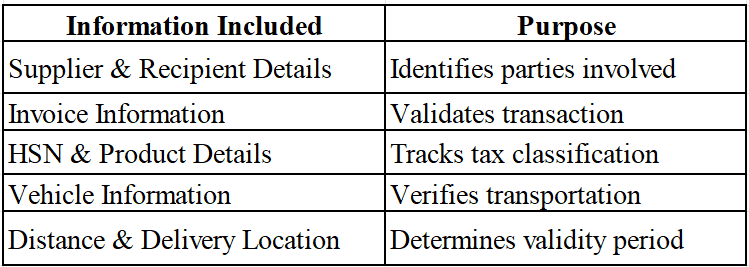
The purpose is simple — to track the movement of goods and reduce tax evasion during transportation.
Why E-Way Bill Errors Have Increased
As businesses grow, dispatch operations become faster and more complex.
Many companies now manage:
- Multiple warehouses
- High shipment volumes
- Third-party transporters
- Inter-state movement
- Marketplace orders
- Same-day dispatch pressure
This operational pressure increases the chances of errors.
Ginesys automates e-way bill generation and GST workflows to help reduce manual mistakes.
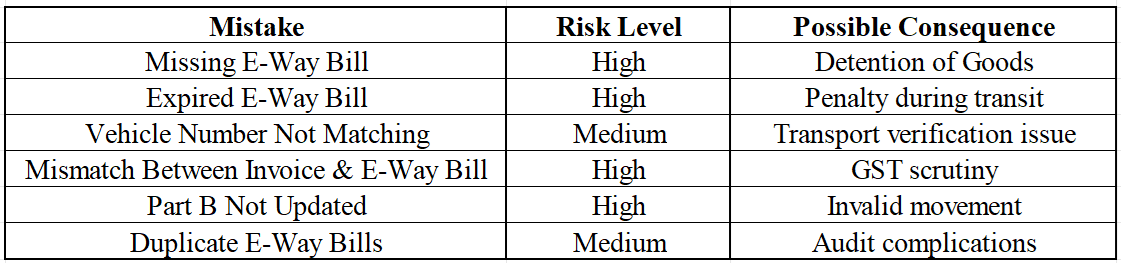
Snapshot: Common E-Way Bill Mistakes
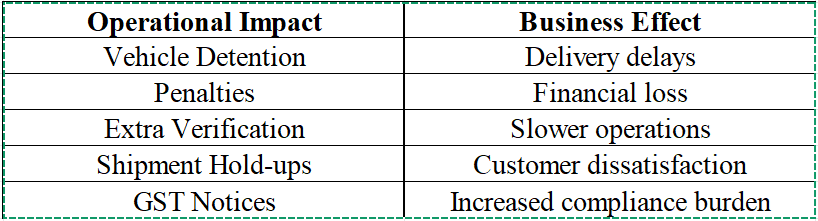
Why These Mistakes Become Serious
Many businesses assume penalties happen only in fraud cases.
That is not entirely true.
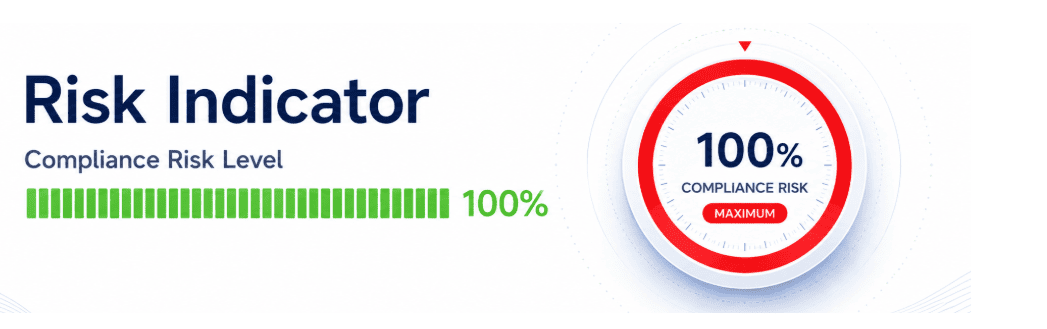
Under GST compliance rules, incorrect or incomplete documentation can sometimes be treated the same way as missing documentation.
This can result in:
1. Transporting Goods Without an E-Way Bill
This is one of the most common mistakes businesses make.
Sometimes, dispatch teams move goods before the E-Way Bill is generated. In other situations, businesses incorrectly assume the shipment value is below the required threshold.
But once goods start moving without proper documentation, the risk becomes serious.
Why This Happens
- Lack of automated systems
- Last-minute dispatch pressure
- Manual invoice creation delays
- Poor communication between the billing and warehouse teams
2. Incorrect GSTIN, Invoice Number, or HSN Code
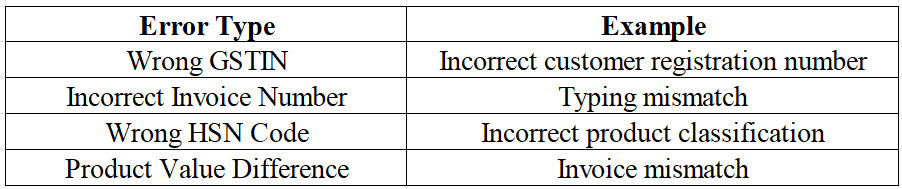
Even one incorrect digit can create a mismatch.
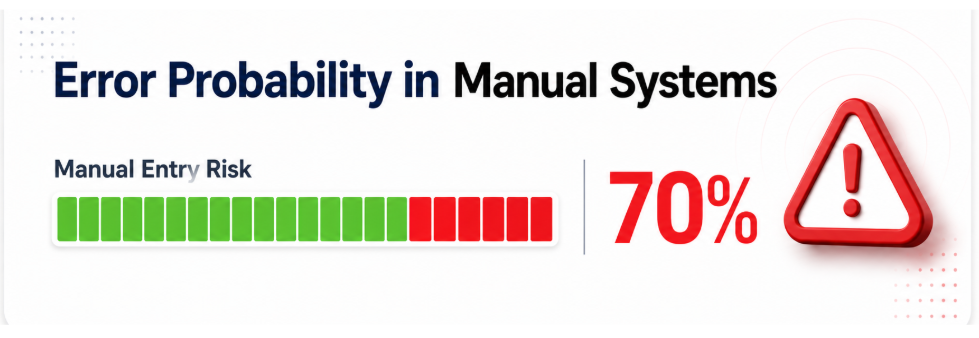
This is one of the biggest problems with manual entry systems. Staff may accidentally enter the wrong GSTIN, invoice number, or HSN code while generating E-Way Bills.
These mistakes often look small internally, but during GST verification, they become major compliance issues.
Common Data Errors
3. Expired E-Way Bills During Transit
This is extremely common during long-distance transportation.
An E-Way Bill has a validity period based on travel distance. Delays due to traffic, weather, vehicle breakdowns, or state border checks can cause the validity to expire before goods reach the destination.
Once expired, the shipment may be treated as movement without a valid E-Way Bill.
Common Causes of Expiry
- Traffic congestion
- Vehicle breakdown
- Route changes
- Delayed unloading
- Transporter coordination issues
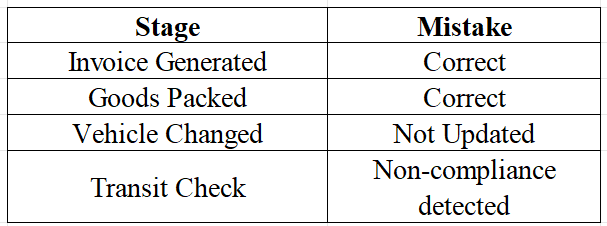
4. Failure to Update Part B Details
Part B contains transporter and vehicle details.
Many businesses complete Part A but forget to update Part B before movement begins. Sometimes the vehicle changes at the last minute and the updated number is never entered. This creates immediate compliance issues during verification.
Typical Operational Problem
5. Mismatch Between Invoice and E-Way Bill
This goes beyond simple typing mistakes.
Here, the invoice details and E-Way Bill details do not match properly.
For example:
- Product mismatch
- Different quantities
- Different HSN codes
- Wrong taxable values
- Incorrect destination addresses
These mismatches immediately raise compliance concerns during inspections.
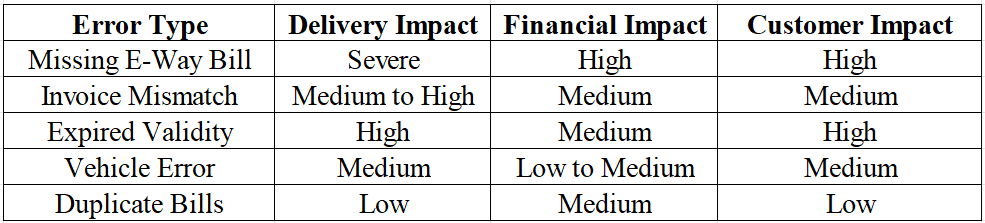
Visual: How E-Way Bill Errors Affect Operations
6. Generating E-Way Bills After Dispatch
Some businesses create E-Way Bills after goods have already started moving.
This usually happens when dispatch operations are rushed.
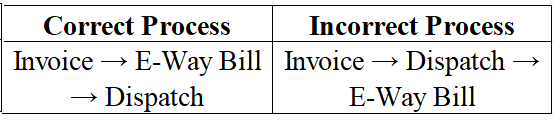
But GST rules require E-Way Bills to be generated before movement begins.
Even if the goods are genuine, delayed generation can still trigger penalties during inspection.
Dispatch Flow Comparison

Automate e-way bills, invoicing, and dispatch workflows with Ginesys
7. Duplicate or Incorrect E-Way Bills
Businesses sometimes create duplicate E-Way Bills accidentally.
This usually happens when:
- Multiple staff members generate bills
- Dispatch plans change suddenly
- Wrong invoices are uploaded
- Systems are not integrated
If incorrect e-way bills are not cancelled properly, audit complications increase later.
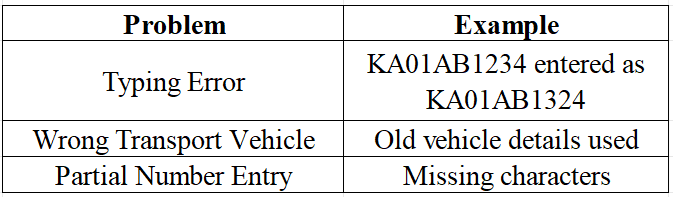
8. Wrong Vehicle Number Entry
Vehicle number mistakes are more common than businesses realize.
A single incorrect letter or number can create problems during transport verification.
During inspections, authorities frequently match the physical vehicle with E-Way Bill records.
Common Vehicle Entry Issues:
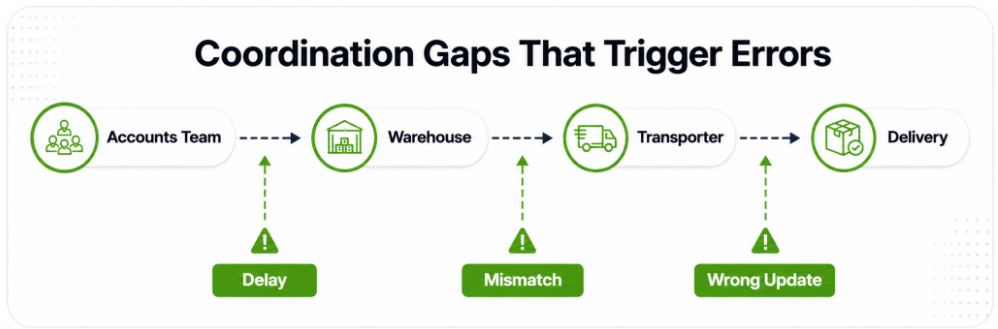
9. Poor Coordination Between Teams
Many E-Way Bill problems are not technical.
They happen because departments work separately.
The accounts team creates invoices, the warehouse team handles packing, and the transporter manages delivery. If communication fails anywhere, mistakes happen.
10. Overdependence on Manual Processes
Manual systems increase compliance risk.
Businesses handling large shipment volumes through spreadsheets or disconnected software often face repeated documentation issues.
The same information gets entered multiple times across invoices, transporter systems, and GST portals.
This repetitive work increases the chances of mistakes.
Manual vs Automated Compliance

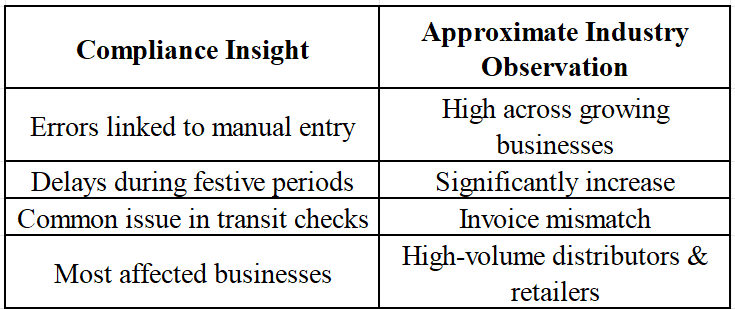
Key Statistics Businesses Should Not Ignore
How Businesses Can Reduce E-Way Bill Errors
Avoiding penalties is not just about understanding GST rules. It is about improving operational accuracy.
Practical Steps Businesses Should Follow:
- Verify invoice details before dispatch
- Automate E-Way Bill generation where possible
- Track validity periods actively
- Update vehicle details immediately
- Reduce manual data entry
- Improve coordination between teams
Why Automation Matters More Now
As shipment volumes increase, manual compliance becomes difficult to manage.
Businesses today are handling:
- Faster dispatch timelines
- Omnichannel fulfillment
- Multiple warehouses
- Third-party logistics coordination
- Large invoice volumes
Without integrated systems, compliance gaps become unavoidable.
Automation helps businesses reduce repetitive work, improve accuracy, and maintain better visibility across dispatch operations.
Minor Errors vs Serious Violations
Not every small mistake immediately results in heavy penalties.
Some GST circulars provide limited relief for minor clerical issues. But businesses should not rely on this casually.
Repeated errors, large mismatches, or suspicious movement patterns can still trigger stricter scrutiny.
The safest approach is always to maintain accurate documentation from the beginning.

Reduce errors, improve dispatch accuracy, and stay GST-compliant with Ginesys.
How EaseMyGST Helps Businesses Reduce E-Way Bill Errors
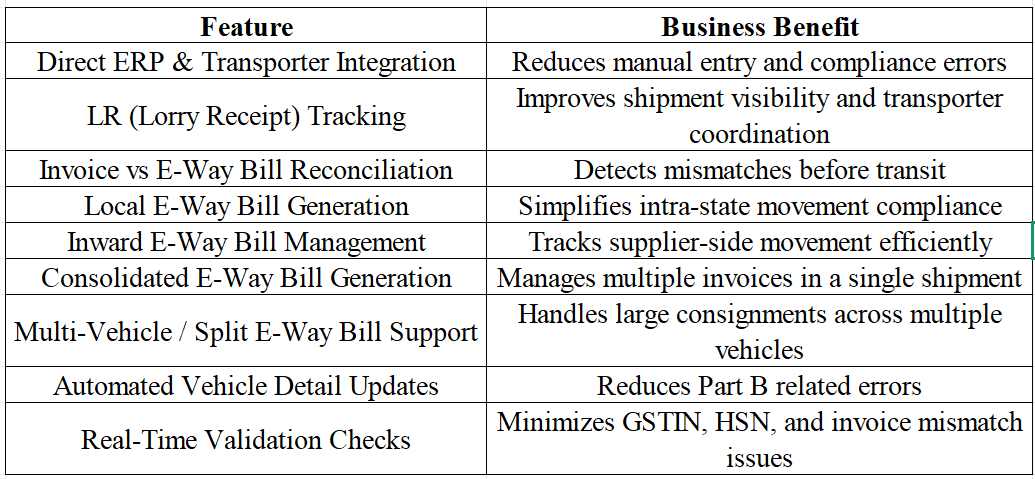
Managing E-Way Bill compliance manually becomes difficult as shipment volumes increase. EaseMyGST helps businesses simplify and automate the entire process with advanced GST and logistics integration capabilities.
Key Capabilities Offered by EaseMyGST
Why Businesses Prefer Automated E-Way Bill Management
With integrated compliance workflows, businesses can:
- Reduce dependency on manual processes
- Improve dispatch accuracy
- Minimize transit delays and GST penalties
- Track shipments more efficiently
- Handle high-volume operations with better control
- Improve coordination between accounts, warehouse, and logistics teams
EaseMyGST enables businesses to create a more reliable, scalable, and compliance-ready dispatch process while reducing operational risks associated with e-way bill management.
E-Way Bill compliance can appear like a small operational task, but even small mistakes can create major business disruptions.
From expired E-Way Bills and invoice mismatches to incorrect vehicle details and delayed generation, these errors can lead to penalties, detained goods, delayed deliveries, and increased GST scrutiny.
As businesses grow, managing compliance manually becomes harder. This is why many companies are shifting toward integrated systems that connect billing, GST compliance, invoicing, and logistics processes together.
Ginesys helps businesses streamline GST-related workflows, reduce manual errors, and improve operational accuracy across inventory, billing, and compliance management.
Streamline GST Compliance with Ginesys. Automate e-way bills, invoicing, and compliance workflows from a single platform.
FAQs
1. What is the penalty for not having an e-way bill in India?
The penalty for transporting goods without a valid e-way bill is ₹10,000 or an amount equal to 100% of the applicable tax on the goods, whichever is higher. This applies under Section 129 of the CGST Act.
2. How long is an e-way bill valid?
Validity is based on distance. For regular cargo, 1 day is allowed per 200 km of travel. For over-dimensional cargo, it is 1 day per 20 km. The validity starts from the time of generation, not the time of dispatch.
3. Can an e-way bill be modified after generation?
Part A of an e-way bill (invoice details) cannot be edited after generation. Part B (vehicle details) can be updated before or during transit if the vehicle changes. If Part A contains errors, the bill must be cancelled within 24 hours and a new one generated.
4. What happens if an e-way bill expires during transit?
If an e-way bill expires before goods reach their destination, the movement is treated as transportation without a valid document. The transporter or consignee can apply for an extension on the GST portal before expiry or within 8 hours after expiry in exceptional circumstances.
5. What is the threshold value for generating an e-way bill?
An e-way bill is mandatory when the value of goods being transported exceeds ₹50,000 in a single invoice or consignment. Certain states have lower thresholds for intra-state movement, so businesses should verify applicable limits for their state.
6. What are the most common reasons for e-way bill rejection or detention?
The most common reasons include: expired validity during transit, mismatch between invoice and e-way bill details (quantity, HSN code, value), incorrect GSTIN, wrong or missing vehicle number in Part B, and generating the e-way bill after goods have already started moving.
7. Is an e-way bill required for all types of goods movement?
No. Certain exemptions apply, including goods transported by non-motorised vehicles, goods moved by railways, goods below the threshold value, and specific categories listed in the GST exemption list. However, businesses should confirm exemptions before assuming they apply.