EaseMyGST E-way Bill Reconciliation: Why Matching Your E-way Bills Matters As Much As Generating Them

Published:
Last Updated:
Quick Answer: E-way bill reconciliation is the process of matching a generated E-way bill against its linked E-invoice and GSTR-1 filing to confirm the values and details agree, so mismatches get caught before they turn into a GST notice.
You are already familiar with the E-way bill drill if you have ever operated a retail firm where products are transported across state boundaries between warehouses, retailers, and customers. Create it, affix it to the shipment, and pray there are no issues.
The fact that creating the E-way bill is only half the work, however, is what most finance teams are unaware of. Reconciling the E-way bill against your E-invoice and your GSTR filings is the other half, which discreetly shields you from future GST notices.
Many retail businesses still struggle with that reconciliation process, which is precisely what Ginesys's GST compliance software, EaseMyGST, is designed to make easier.
Key Takeaway:
Generating an E-way bill is only half of GST compliance. Reconciling it against the linked E-invoice and GSTR-1 filing is what actually protects a retailer from mismatches and GST notices, and EaseMyGST closes that loop with single-click reconciliation built into the same Ginesys ERP and POS workflow used to generate the documents in the first place.

Ready to close the reconciliation gap in your GST compliance?
First, What's Actually at Stake
An E-way bill is an electronic document that becomes mandatory once you're moving goods worth more than a specified value under GST rules. It exists to keep the movement of goods transparent and to make tax evasion harder to get away with.
For retailers, especially the ones running operations across multiple states, generating one correctly for every qualifying shipment isn't optional. Miss it, or get it wrong, and you're looking at penalties and delayed deliveries.
And the volume involved is genuinely large.
E-way bill generation across India touched an all-time high of 9.73 crore bills in February 2024 alone, per GST Network (GSTN) data, which gives you a sense of just how much goods movement, and how much compliance risk, is riding on this one document.
The GST Network has also tightened the rules recently. Updates rolling out from January 2025 restrict the generation of E-way bills for documents older than 180 days and cap extensions at 360 days from the date of original generation. In other words, the margin for "we'll fix it later" is shrinking.
Why Manual E-way Bill Handling Breaks Down
If your team is still generating E-way bills manually, you already know the pain points: it's slow, it eats up hours during high-volume periods, and it's easy for a data entry slip to turn into a compliance headache.
There's no real-time visibility into what's in transit, no easy way to catch an E-way bill that's about to expire, and definitely no simple way to check whether the E-way bill you generated actually lines up with the E-invoice it's supposed to be based on.
That last part is the one businesses tend to overlook. If you're running your accounting through something like Tally, for instance, there's genuinely no built-in way to check which E-invoices have had matching E-way bills generated against them.
You'd have to export both data sets to Excel and manually reconcile them line by line: invoice number by invoice number, value by value. For a business processing even a moderate volume of shipments, that's not a sustainable workflow.
Here's the difference reconciliation approach makes in practice:
| Factor | Manual Reconciliation | EaseMyGST Reconciliation |
|---|---|---|
| E-way bill vs E-invoice matching | Exported to Excel, checked line by line | Single-click dashboard match |
| GSTR-1 tie-out | A separate manual exercise | Same reconciled data feeds GSTR-1 prep |
| Vendor GSTIN / filing status | No visibility without a separate lookup | Checked in real time via direct GSTN connection |
| Expiry or mismatch alerts | None, tracked manually | Automated alerts before it becomes a problem |
| Time per E-way bill | 20 to 30 minutes of manual entry | A couple of clicks |
Where Reconciliation Actually Comes In
This is the piece that EaseMyGST handles differently.
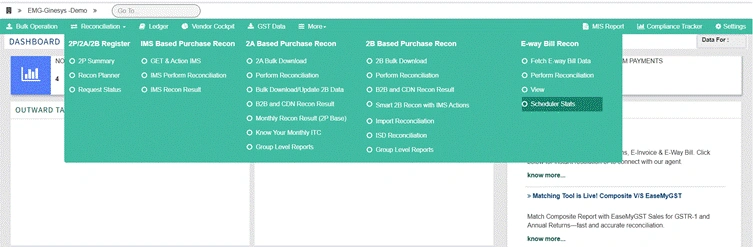
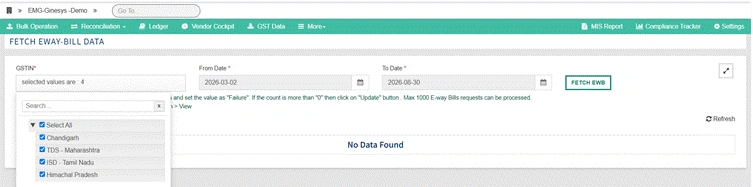
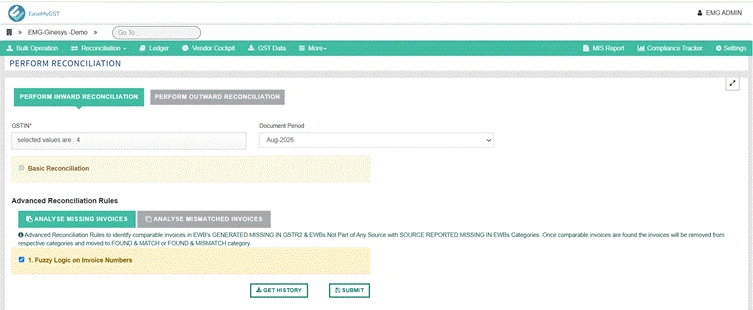
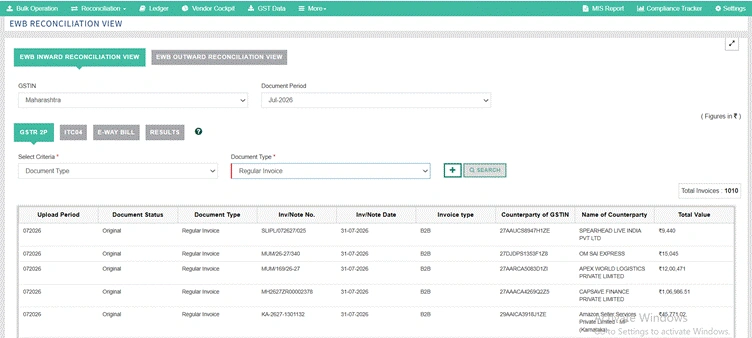
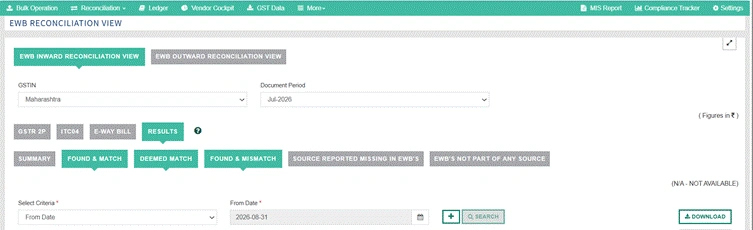
Instead of leaving you to cross-check E-invoices against E-way bills in a spreadsheet, the platform offers single-click reconciliation between the two.
You get a straightforward dashboard that tells you whether every E-way bill has actually been generated, and whether the values and details on it match what's on the corresponding E-invoice.
That reconciliation doesn't stop at the E-invoice level either.
It also feeds into your GSTR-1 preparation too. EaseMyGST reconciles e-invoices and e-way bills against your GSTR-1 filing to make sure what you're reporting is accurate, and then uses that reconciled e-invoice data to help prepare GSTR-1 automatically.
So the same reconciliation exercise that catches a mismatched E-way bill also tightens up your monthly return filing.
There's a vendor-side check built in as well.
Because EaseMyGST connects directly to GSTN, you can see whether a vendor's GSTIN is active or inactive, whether they're generating e-invoices, and what their GST filing status looks like. This is useful context when you're trying to figure out why a particular e-way bill or invoice isn't matching up cleanly.

See every E-way bill matched against its E-invoice, automatically.
How the Generation-to-Reconciliation Flow Works
For businesses running Ginesys ERP or Ginesys POS, the process is designed to stay within your existing systems rather than asking you to work in a separate portal.
Broadly, it looks like this: you generate a regular invoice in Ginesys ERP, Ginesys POS, or another pre-integrated ERP with the GSTIN entered correctly. That invoice data goes to EaseMyGST, which generates the Invoice Reference Number (IRN) by validating the details and uploading them to the Invoice Registration Portal (IRP).
The IRP then automatically forwards the payload to generate the E-way bill. Finally, the IRN data syncs back from EaseMyGST to the original e-invoice, so you can print it with the QR code intact.
What used to take twenty to thirty minutes of manual entry per e-way bill, with real risk of duplicate entries at the NIC portal, now comes down to a couple of clicks.
The integration also runs on a built-in GST rule engine that validates the data before generation, so errors get caught before they become compliance problems rather than after.
For businesses managing operations across several states, there's a centralised login that covers all your GSTINs, plus workflows that can be organised state-wise, location-wise, or even sub-location-wise within a single account.
You can email the e-waybill directly to the consignee, transporter, and consignor and track expiry or cancellation status in near real-time, which is especially useful given how strict the new 180-day and 360-day limits are.
There's also support for multi-vehicle and consolidated e-way bill generation, plus a pincode-based distance calculator, which matters when the system needs to validate the transport distance you've entered.
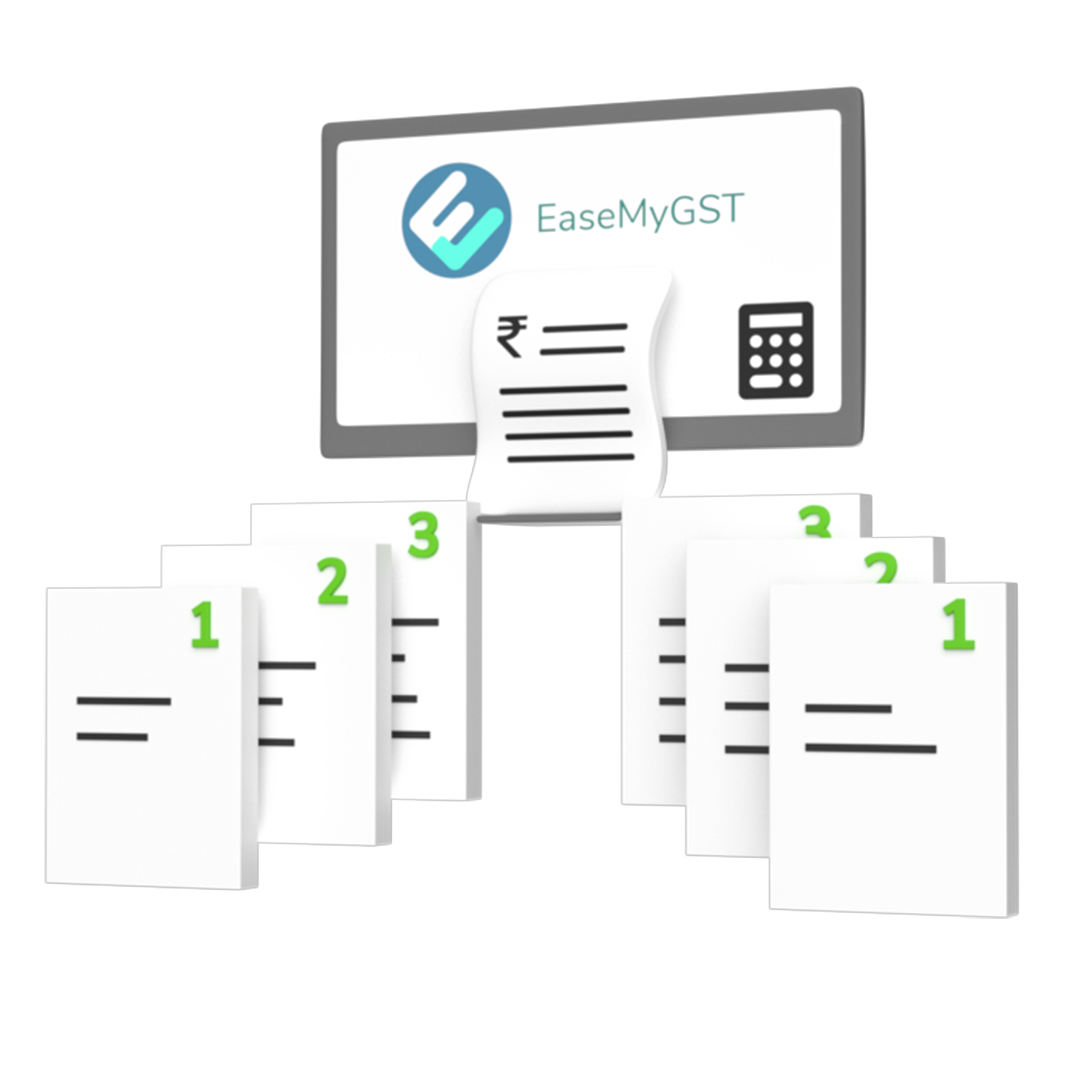
One dashboard for e-invoicing, e-way bills, and GST return filing.
What to Look for If You're Evaluating an E-way Bill Solution
If you're assessing whether your current setup is good enough, a few things are worth checking for specifically: real-time integration with the GST portal so validation happens as you generate, support for bulk uploads and APIs rather than one-off manual entry, solid tracking and reporting so you can see what's pending or about to expire, and automated alerts for expirations or mismatches so nothing slips through during a busy dispatch period.
A system that's genuinely built for retail volume should also support customisable workflows, since a single-location D2C brand and a fifty-store apparel chain don't need the same setup.
The Bigger Picture
Complying with e-way bills involves more than just avoiding fines at checkpoints. When your GST filings are examined, it is important to ensure that the paper trail (the e-invoice, e-way bill, and GSTR-1) tells a consistent story. That loop is closed through reconciliation.
The E-way bill's generation facilitates the movement of products, and its reconciliation with your invoices and returns is what keeps your compliance record spotless months later, when it really counts.
It's worthwhile to consider how much of your E-way bill processing may be done under a single dashboard if you now rely on manual cross-checks or spreadsheet reconciliation.
To find out how the EaseMyGST and Ginesys ERP/POS connection might suit your unique shipment quantities and GSTIN structure, get in touch with the Ginesys team.

Talk to a Ginesys GST compliance expert about your shipment volumes.
FAQs
1. What is E-way bill reconciliation?
E-way bill reconciliation is the process of matching a generated E-way bill against its linked E-invoice and GSTR-1 filing to confirm the values, invoice numbers, and details all agree, so retailers can catch mismatches before they turn into GST notices.
2. Why isn't generating an E-way bill enough for GST compliance?
Generating an E-way bill only covers the movement of goods. Without reconciling it against the E-invoice and GSTR-1 filing, a mismatch in values or invoice details can go unnoticed until a GST audit surfaces it, by which point it is harder to trace and fix.
3. How does EaseMyGST reconcile E-way bills with E-invoices?
EaseMyGST offers single-click reconciliation through a dashboard that checks whether every E-way bill has been generated and whether its values and details match the corresponding E-invoice, replacing manual line-by-line checks in a spreadsheet.
4. Does E-way bill reconciliation help with GSTR-1 filing?
Yes. EaseMyGST reconciles e-invoices and e-way bills against GSTR-1 filings and uses that reconciled data to help prepare GSTR-1 automatically, so the same reconciliation exercise that catches a mismatched E-way bill also supports monthly return filing.
5. Can EaseMyGST check a vendor's GST filing status?
Yes. Because EaseMyGST connects directly to GSTN, retailers can check whether a vendor's GSTIN is active, whether the vendor is generating e-invoices, and what their GST filing status looks like, which helps explain why a particular e-way bill or invoice is not matching up cleanly.
6. What is the new 180-day and 360-day rule for E-way bills?
Under updates effective from January 2025, the GST Network restricts E-way bill generation to base documents no older than 180 days and caps extensions at 360 days from the date of original generation, which narrows the window for correcting mismatches after the fact.