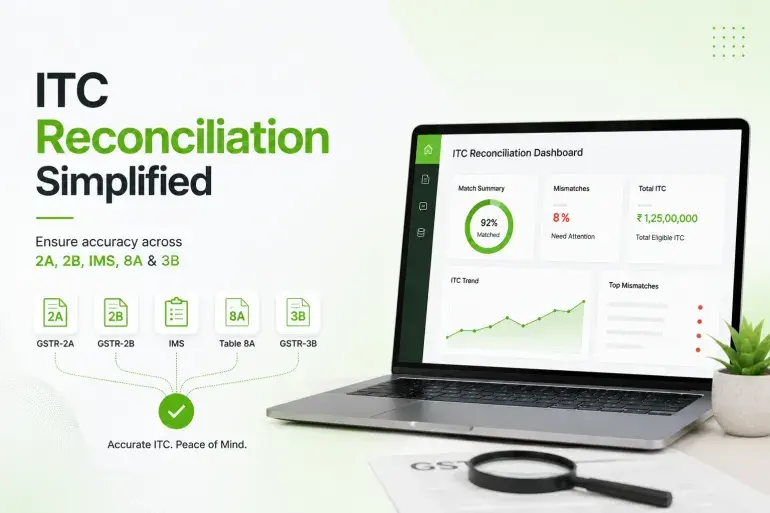
The Real Challenges Taxpayers Face in ITC Reconciliation Across 2A, 2B, IMS, 8A & GSTR 3B
Published:
Last Updated:
Quick Answer: ITC reconciliation is hard because GSTR-2A, GSTR-2B, IMS, Table 8A, and GSTR-3B all have to agree with each other every month, for every vendor, and a single unfiled or late supplier return can block or reverse credit that's rightfully yours unless it's caught early.
Ask any finance team handling GST compliance what the single most time-consuming part of their month is, and there's a good chance the answer involves the letters "ITC reconciliation".
Not because the concept is complicated, matching what you've claimed as input tax credit against what your suppliers have actually reported, but because doing it across GSTR-2A, GSTR-2B, IMS, Table 8A, and GSTR-3B all at once, every single month, for every vendor, is genuinely hard to do without something breaking.
Here's a walk-through of where the real difficulty sits and why so many businesses end up dealing with lost credit, mismatches, and the occasional GST notice as a result.
Key Takeaway:
ITC claims are now limited to what actually shows up in GSTR-2B, and with GSTR-3B's auto-populated liability now hard-locked, an error caught late costs at least a full return cycle to fix instead of a same-month correction. Businesses that avoid this run continuous, automated matching across 2A, 2B, IMS, and vendor GSTIN status instead of a manual, once-a-month sweep, which is exactly what EaseMyGST is built to do.

Ready to stop reconciling 2A, 2B, IMS, and 8A by hand?
The Basic Problem: Reconciliation Isn't Optional Anymore
At its core, ITC reconciliation is the process of matching your purchase data against the invoices your suppliers have raised and matching your sales against what your customers have recorded on their end.
It sounds simple on paper. In practice, doing this manually or in Excel is tedious and genuinely time-consuming, and the stakes have only gone up.
The GST Council has tightened the rules so that ITC claims are now limited to what actually shows up in GSTR-2B, which means manual, once-a-month matching simply can't keep pace anymore. Errors go unnoticed, deadlines get missed, and credit that was rightfully yours ends up written off.
Here's how the five layers that all have to agree fit together:
| Layer | What It Is | Why It Matters |
|---|---|---|
| GSTR-2A | Draws from supplier filings | One half of the monthly matching exercise |
| GSTR-2B | Also draws from supplier filings, but static for the period | ITC claims are now legally limited to what shows up here |
| IMS | Invoice Management System sitting on top of 2A/2B | Meant to simplify things, but adds another layer to reconcile |
| Table 8A | Part of GSTR-9, the annual return | Where mismatches against GSTR-2A resurface every filing season |
| GSTR-3B | Monthly return with auto-populated liability | Now hard-locked, so errors cost a full return cycle to fix |
Where GSTR-2A and GSTR-2B Diverge (and Why That's a Problem)
GSTR-2A and GSTR-2B both draw from supplier filings, but they behave differently, and that difference is a common source of confusion.
The government has made it mandatory for filers to incorporate GSTR-2B data into their GSTR-3B, which puts a lot of weight on your vendors filing their GSTR-1 accurately and on time. Because if they don't, your GSTR-2B simply won't reflect the credit you're expecting.
This creates a very specific, very costly scenario. Say ₹5 lakh worth of ITC is missing from your GSTR-2B because a handful of vendors haven't filed properly.
If you catch that early, you still have a window to follow up with those vendors, get their returns corrected, and make sure the credit flows through before your own filing deadline.
Catch it late, or not at all, and that ₹5 lakh is either blocked, reversed, or claimed incorrectly, which then invites interest charges and, potentially, a notice months down the line. The financial impact isn't theoretical; it's a direct hit to working capital.

Catch a missing ₹5 lakh in ITC before it becomes a notice.
The IMS Layer Adds Real Complexity
The Invoice Management System (IMS) was meant to make life easier, but it's also added another layer that businesses now have to reconcile against.
Traditional GST reconciliation already meant manually comparing GSTR-2A, GSTR-2B, and your purchase register. For high-volume businesses, that can mean reviewing thousands of invoices in a single month.
Doing that by hand is not just slow; it's genuinely prone to fatigue errors: missed mismatches, duplicate ITC claims slipping through, and no real-time sense of whether your return is even accurate until it's too late to fix.
The businesses that get IMS reconciliation right typically aren't relying on invoice number matching alone. Matching also needs to account for date, value, GSTIN, tolerance limits for near-matches, and tracking of amended invoices and document types.
Multi-GSTIN and multi-ERP businesses face an extra wrinkle here too: if your purchase data is coming from Ginesys, Tally, SAP, or Oracle across different locations, you need all of that consolidated into one place before reconciliation can even start, rather than working GSTIN by GSTIN in isolation.
The Table 8A Headache Around GSTR-9 Time
Even businesses that stay on top of monthly reconciliation tend to run into friction once GSTR-9 filing season arrives, specifically around Table 8A.
A common and recurring issue is a mismatch between the ITC values reflected in GSTR-2A and what appears in Table 8A of the annual return, usually traced back to suppliers filing GSTR-1 late, not filing it at all, or amending invoices after the fact.
None of that is within your direct control, which is exactly why it needs to be caught and addressed through the year rather than discovered in December.
GSTR-3B Hard-Locking Has Raised the Stakes
A relatively recent shift has made all of this less forgiving.
With auto-populated liability in GSTR-3B now hard-locked, any errors in GSTR-1 can no longer be corrected within GSTR-3B itself. Corrections have to happen in the following month's return instead, which can create real cash flow disruption.
This makes accurate GSTR-1 filing and ensuring your GSTR-1, e-invoices, and e-way bills are all aligned with each other more important than it used to be.
Practically, this means IMS reconciliation and GSTR-2B regeneration now sit upstream of a decision that used to have more room for correction. Get it wrong, and you're living with the consequence for at least a full return cycle.
One dashboard to keep 2A, 2B, IMS, and 3B in agreement.
Vendor Compliance: The Variable You Can't Fully Control
A lot of ITC reconciliation pain doesn't actually originate in your own books. It originates with your vendors.
A missing invoice in your IMS or GSTR-2B, caused by a vendor who hasn't filed, is lost ITC as far as your return is concerned, regardless of whether you actually paid that vendor and hold a valid invoice.
This is why vendor-side visibility matters as much as invoice-side matching: knowing whether a vendor's GSTIN is currently active, whether they're filing on time, and whether they have a history of late or inconsistent filing lets you flag risk before it turns into missing credit.
What Actually Helps
Given how many moving pieces are involved (2A, 2B, IMS, Table 8A, GSTR-3B, and vendor behaviour on top of all of it), the businesses that handle this well tend to share a few habits, which is also where a platform like EaseMyGST does the heavy lifting.
- Automated matching against GSTR-2A/2B, using rule-based logic across invoice number, GSTIN, tax values, and dates, with tolerance settings for near-matches, rather than manual, line-by-line checking.
- PAN-level, GSTIN-level, and vendor-level views in one place, so multi-GSTIN businesses aren't reconciling in silos.
- Bulk vendor GSTIN status checks, flagging inactive GSTINs or vendors with a history of filing delays before they become a credit problem.
- Continuous monitoring rather than a monthly sweep: real-time alerts for missing invoices, ITC mismatches, and vendor filing delays as they happen, not weeks later.
- Built-in vendor communication, so chasing a supplier for a missing or corrected invoice is a bulk email and a tracked response, not an individual follow-up call.
- Audit-ready reporting: mismatch summaries, ITC claimed versus available, amendment tracking, and GSTR-2B versus purchase register logs are kept current rather than assembled after the fact.
- Compliance guardrails at the claim stage itself, preventing ITC claims on invoices tied to inactive vendor GSTINs or unfiled returns before they ever reach your GSTR-3B.
None of this makes ITC reconciliation a non-issue. The underlying complexity of 2A, 2B, IMS, and 8A all needing to agree with each other month after month isn't going away.
But the difference between finding a ₹5 lakh mismatch three weeks before your deadline versus three days before it is entirely about whether reconciliation is a continuous, automated process or a manual scramble.
For businesses still relying on spreadsheets to bridge that gap, it's worth talking to the Ginesys team about how much of this EaseMyGST can already be doing in the background.

Talk to a Ginesys GST compliance expert about your reconciliation load.
FAQs
1. What is ITC reconciliation?
ITC reconciliation is the process of matching what a business has claimed as input tax credit against what its suppliers have actually reported, and matching its sales against what customers have recorded, across GSTR-2A, GSTR-2B, IMS, Table 8A, and GSTR-3B.
2. Why is ITC reconciliation harder now than before?
The GST Council has tightened the rules so that ITC claims are now limited to what actually shows up in GSTR-2B, which means manual, once-a-month matching can no longer keep pace. Errors go unnoticed, deadlines get missed, and rightfully owed credit ends up written off.
3. What is the difference between GSTR-2A and GSTR-2B?
Both GSTR-2A and GSTR-2B draw from supplier filings, but they behave differently, and ITC claims are now legally limited to what shows up in GSTR-2B specifically, since the government has made it mandatory to incorporate GSTR-2B data into GSTR-3B.
4. What does the Invoice Management System (IMS) add to reconciliation?
IMS adds another layer that businesses have to reconcile against on top of GSTR-2A and GSTR-2B. Getting it right requires matching on date, value, GSTIN, tolerance limits for near-matches, and tracking of amended invoices, not just invoice number alone.
5. Why does Table 8A cause problems during GSTR-9 filing?
A common and recurring issue is a mismatch between the ITC values reflected in GSTR-2A and what appears in Table 8A of the annual return, usually traced back to suppliers filing GSTR-1 late, not filing it at all, or amending invoices after the fact.
6. What changed with GSTR-3B hard-locking?
With auto-populated liability in GSTR-3B now hard-locked, errors in GSTR-1 can no longer be corrected within GSTR-3B itself. Corrections have to happen in the following month's return instead, which can create real cash flow disruption.
7. How does EaseMyGST help with ITC reconciliation?
EaseMyGST runs automated, rule-based matching against GSTR-2A/2B with tolerance settings for near-matches, gives PAN-level, GSTIN-level, and vendor-level views in one place, runs bulk vendor GSTIN status checks, sends real-time alerts for mismatches, and applies compliance guardrails before an ITC claim ever reaches GSTR-3B.