Best Integrations with Retail ERP Updated for Ginesys (2026)
Published:
Last Updated:
Running a retail business across stores, warehouses, and online channels means managing a lot of moving parts. And increasingly, the quality of those decisions depends less on any single tool and more on how well those tools share information with each other.
That shift has been building for a while, but 2026 looks different from even two years ago. RFID-driven inventory counts, connected OMS-WMS workflows, and AI-assisted analytics have moved up the priority list for a much wider range of retailers. What was once associated with large enterprise operations is now a realistic consideration for growing mid-market businesses looking to improve inventory visibility and reduce the cost of manual coordination.
This guide covers what retail ERP integration needs to deliver in 2026, the categories that matter most for retailers operating across multiple channels, and what to look for when evaluating how well your systems are actually working together.
Key Takeaway:
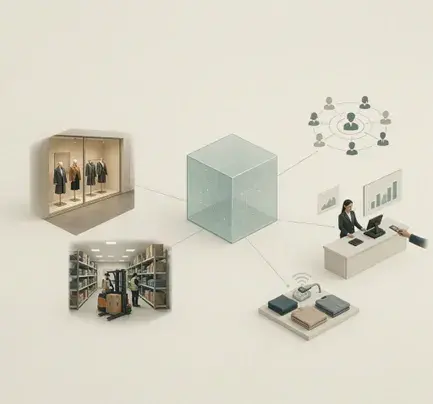
The retail ERP integrations that hold up in 2026 run on one shared data layer rather than point-to-point connections bolted on over time, with POS, WMS, OMS, marketplace, CRM, finance, and RFID data all updating the same central record in real time, so a new store, channel, or system can be added without a separate integration project or a reconciliation period.

See how Ginesys One connects ERP, POS, OMS, WMS, marketplaces and analytics on a unified architecture.
Why Retailers Need a Connected ERP Ecosystem
Most of the case for integration comes down to what breaks when systems don't talk to each other. Inventory, sales and accounting running as separate tools means someone's re-entering the same data twice, and every re-entry is a chance for a number to come out wrong. Connecting these systems can reduce duplicate data entry and give teams more time for work that requires human judgment.
Speed matters just as much as accuracy. A retailer working off yesterday's stock numbers is making today's decisions on old information, and in a category where online and offline inventory need to match constantly, that lag shows up fast, usually as an oversold item or a stockout nobody saw coming. Where real-time synchronisation is supported, pricing, inventory and customer data can be kept more current across channels.
Customers feel the difference too, even if they'd never describe it in ERP terms. Accurate stock visibility means fewer "sorry, that's out of stock" moments at checkout, faster order processing, and service that doesn't fall apart the moment a query crosses channels. And on the cost side, every silo a retailer removes tends to remove a category of error along with it: pricing mismatches, duplicate orders, inventory that's wrong in one system and right in another.
The bigger benefit is flexibility. A retailer can connect the systems it needs today while keeping room for new channels, applications and data sources as its operating model changes.
What to Look for in a Retail ERP Integration
Not every integration is built the same way, and the difference shows up quickly once a business scales past a handful of stores. The systems that hold up share a few things in common.
Data has to flow across POS, CRM, supply chain, and finance in real time; batch syncs that update overnight leave gaps that a fast-moving retailer can't afford. Inventory needs one central view rather than a dozen store-level snapshots, because accurate forecasting and fulfilment both depend on knowing what's actually on hand, not what a system thought was on hand yesterday. Sales and marketing work better when they're working from the same live data. When they operate as separate workflows, alignment often comes only through month-end reporting. And omnichannel only works when pricing and promotions stay consistent wherever a customer looks. Few things erode customer trust faster than price inconsistency across channels.
Which Retail ERP Integrations Matter Most in 2026?
A few habits separate integrations that hold up from ones that create new problems six months in. Start by mapping what's already running, POS, CRM, warehouse tools, before adding anything new, so effort goes toward genuine gaps instead of duplicate coverage. Lean on API-based integration wherever possible. It handles real-time data exchange better than older methods and scales more easily as the business adds channels or locations. And build security in from the start rather than retrofitting it later. It's much harder to add encryption, authentication, and access controls after a compliance review flags a gap than to design them in from the beginning.
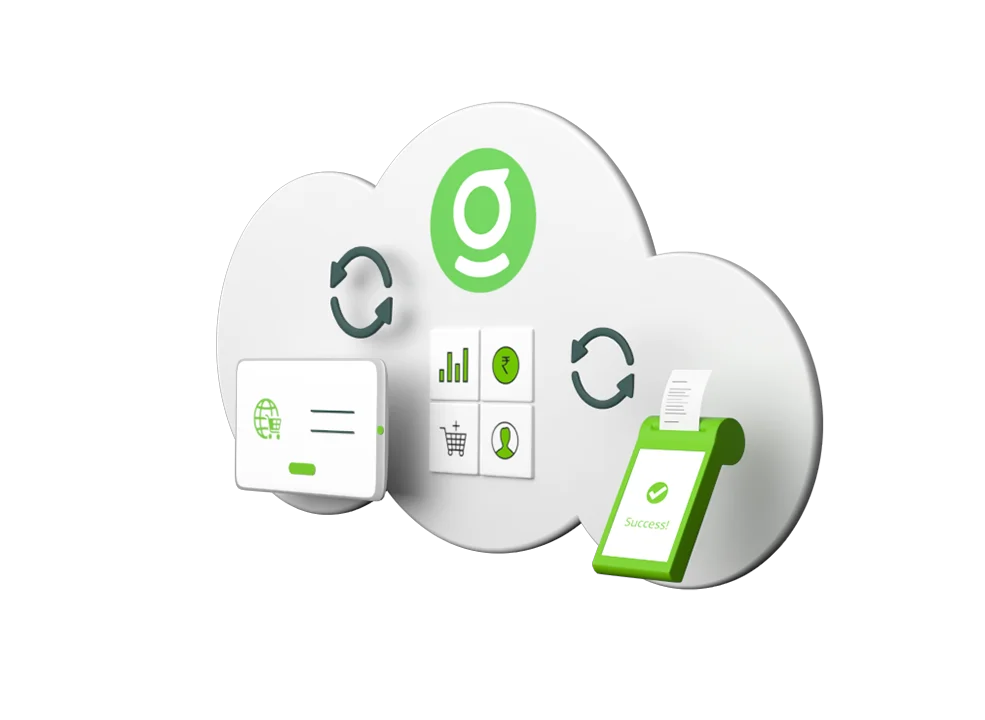
Explore how Ginesys One connects your existing retail operations while keeping data, inventory and workflows aligned in real time.
What to Consider Before Integrating a Retail ERP
The real advantage isn't that all these integrations exist; most ERPs can eventually connect to most things. It's that they run on one data layer instead of being stitched together after the fact, which can significantly shorten implementation timelines and reduce the overhead of managing multiple vendor relationships.
The question worth asking in 2026 isn't just whether a system integrates with what a retailer already uses. It's whether the system is built to keep integrating as the business adds channels and capabilities it hasn't needed yet. That's the gap between an ERP with integrations layered on over the years and a platform designed, from the ground up, to absorb whatever comes next (RFID, new marketplaces, AI-driven analytics) typically without requiring a full rebuild each time.
Connect your stores, warehouses, marketplaces, finance and customer data without building a patchwork of disconnected systems.
How Ginesys Brings Retail Systems Together
Ginesys brings these pieces together on one architecture rather than as a patchwork of separately maintained connections.
On the store side, POS integration keeps item master data, transactions, inter-store stock transfers and cash reconciliation synced with the ERP as they happen, not at end of day. CRM integration pulls customer and vendor data into the same system, supporting more personal marketing and steadier vendor relationships. For online selling, the order management layer keeps stock accurate across major marketplaces and webstores, which is the difference between significantly reducing the risk of oversells that result in post-order cancellations and customer apologies.
GST integration handles e-invoicing and e-way bills with minimal manual intervention, reducing compliance overhead significantly. BI integration pulls sales, inventory and customer data into one place for analysis instead of multiple exports someone has to reconcile manually. On the supply side, vendor onboarding, RFP management and ASN tracking keep procurement coordinated, and warehouse management tracks inventory movement, storage and picking accuracy as it happens on the floor.
RFID is an addition worth calling out specifically. It makes item-level inventory control practical at scale. For fashion and lifestyle retailers, that means tighter inventory control and much faster counts than manual scanning allows.

Want a second opinion on your integration roadmap? Talk to a Ginesys expert about what's already running and what still needs to connect.
Frequently Asked Questions (FAQs)
How long does it typically take to integrate a retail ERP like Ginesys One with existing store systems?
For a retailer with an established POS and a few active marketplace channels, a phased integration rollout usually runs a few weeks, depending on data complexity and the number of locations. Brands that have done a data audit before starting, cleaning up SKU records, customer data, and inventory counts, consistently move faster than those cleaning data mid-implementation.
Does Ginesys One require replacing existing tools, or can it integrate with what's already running?
Ginesys One is built to connect with existing infrastructure rather than replace it wholesale. API-based integration means it works alongside tools already in the stack, accounting software like Tally, payment gateways, existing marketplace accounts, rather than forcing a clean break. The specific integration map depends on what's currently running, which is worth mapping before any decision is made.
What happens to data accuracy when a new channel or warehouse is added after go-live?
Because Ginesys runs on a shared data layer rather than point-to-point connections, adding a new store, warehouse, or marketplace channel joins the existing architecture rather than requiring a separate integration project. Inventory counts, pricing, and order data extend to the new touchpoint from day one, without a parallel reconciliation period while the new system catches up to the rest.
Is RFID integration worth adopting for a mid-market retailer, or is it only useful at enterprise scale?
RFID's value scales with SKU and variant complexity more than with company size. A fashion or lifestyle retailer with a large style-size-colour matrix sees a faster payback from item-level accuracy and faster counts than a retailer with simpler, lower-variant inventory, regardless of store count.
What's the biggest risk in integrating a retail ERP with too many point solutions instead of a unified platform?
Each point-to-point connection is a separate thing that can break, get outdated, or fall out of sync as either system updates, and troubleshooting a data mismatch means figuring out which of several connectors is the source. A unified architecture on one data layer removes that failure surface, since every module reads and writes to the same central record.