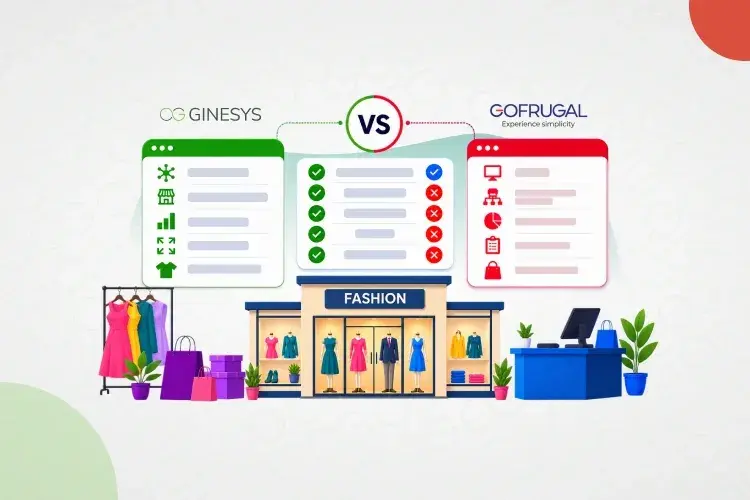
Ginesys vs Gofrugal for Multi-Store Fashion Brands
Published:
Last Updated:
Choosing retail software for a growing fashion brand is rarely about comparing feature lists. The real challenge begins when the business expands across multiple stores, warehouses, marketplaces, and D2C channels, where every sale, stock movement, and customer order depends on inventory remaining accurate in real time. What works well for a five-store retailer can quickly become difficult to manage at fifty stores, particularly when thousands of style-size-colour variants, omnichannel fulfilment, replenishment, and merchandising decisions all rely on the same operational data. That is why retailers evaluating Ginesys and Gofrugal should look beyond individual features and understand how each platform is designed to support long-term retail growth.
Comparison Disclaimer: Gofrugal is a product suite of Zoho Corporation Private Limited. Ginesys and Ginesys One are products and trademarks of Ginni Systems Limited. All comparisons in this article are based on publicly available product information reviewed as of August 7, 2026. Product features, integrations, pricing, and functionality may change over time. Retailers should verify current functionality, availability, and suitability directly with the respective vendors before making a purchasing decision.
Key Takeaway:
For fashion retailers running 20+ stores across owned, franchise, and marketplace channels, the platform choice that matters most is whether variant-level inventory (style, size, colour) is native to the core system or bolted on. Ginesys is built as a fashion-first retail ERP with native style-size-colour variant management, connected POS, warehouse operations, and OMS on one data layer, while Gofrugal is a broader multi-vertical retail platform with apparel capabilities added on top. That structural difference is what determines how cleanly markdown timing, working capital allocation, and marketplace fulfilment scale as store count grows.

See which platform is built to run fashion retail at your scale.
Understanding Where Each Platform Fits
Gofrugal: Multi-Vertical Retail Software
Gofrugal is a multi-vertical retail platform serving businesses across retail and other industries, with dedicated capabilities for apparel and garment retail. Its apparel solutions cover inventory, procurement, POS, replenishment, barcode management, pricing, reporting, and multi-location operations, with support for apparel product variants such as size and colour. Its broader retail platform also includes CRM, loyalty, warehouse management, omnichannel capabilities, and integrations. Fashion retailers should evaluate how these capabilities align with their specific operating model, scale, and merchandising requirements.
Ginesys: Fashion-First Retail ERP
Ginesys focuses on fashion and lifestyle retail, bringing together ERP, procurement, production management, inventory management, warehouse operations, wholesale, Ginesys POS, OMS, and data analytics on one connected retail platform. The platform supports fashion-specific workflows including product variants, seasonal collections, production planning, merchandising, replenishment, and omnichannel retail operations.
Ginesys vs Gofrugal: How They Stack Up
| Capability | Gofrugal | Ginesys |
|---|---|---|
| Industry Focus | Serves multiple retail verticals, including apparel and garment retail but suited for offline retail | Generic omnichannel retail software well suited for fashion, footwear, lifestyle, and specialty retail |
| Inventory Management | Centralized, multi-location inventory with variant management, stock transfers, replenishment, and omnichannel inventory capabilities | Variant-level inventory across stores, warehouses, wholesale, marketplaces, and D2C channels |
| Warehouse Management | Warehouse and stock operations including receiving, stock picking, stock counting, transfers, and inventory control | Native warehouse management integrated with ERP, OMS, procurement, and inventory on mobile app |
| Procurement | Procurement and purchase management | Procurement integrated with fashion retail ERP and merchandising workflows |
| Production Management | No directly comparable apparel production-management capability identified | Integrated production management for fashion and lifestyle retail within Ginesys ERP |
| Finance & Accounting | Integrated finance and accounting capabilities through Zoho | Retail ERP with integrated finance and commercial workflows |
| Wholesale Operations | Multi-outlet and retail-chain management; specific wholesale requirements should be verified | Wholesale, franchise, and omnichannel distribution management |
| POS | Cloud POS and retail POS capabilities for multi-location operations | Ginesys POS is available in desktop and cloud editions and is integrated with ERP, OMS, and inventory management |
| Order Management | Omnichannel order management with ecommerce integrations but it is for inventory sync from POS only | Ginesys OMS (formerly Browntape) with unified order orchestration across stores, marketplaces, and D2C is 2-way integrated with ERP and POS |
| Marketplace & Ecommerce | Ecommerce and marketplace integrations through its omnichannel ecosystem and APIs; specific channel availability should be verified for each implementation | Marketplace and D2C integrations through the Ginesys ecosystem; specific current integrations should be verified before implementation |
| Analytics & Reporting | Business intelligence and operational reporting | Data analytics with merchandising, inventory, and retail performance insights |
| Fashion Retail Capabilities | Apparel-specific capabilities including variant management, inventory, replenishment, POS, pricing, barcode management, and reporting | Fashion-focused platform supporting size-colour-style management, seasonal buying, merchandising, production, replenishment, and omnichannel retail |
What the Platform Decision Affects on the P&L
The impact of retail software rarely appears immediately after implementation. Instead, it becomes visible through inventory decisions, replenishment accuracy, working capital utilisation, and fulfilment performance over time. As fashion retailers scale, these operational differences begin influencing margins, stock availability, customer experience, and overall profitability. Three areas typically reveal the largest commercial impact.
As fashion retailers scale, three operational areas typically have the greatest impact on profitability. Each becomes progressively harder to manage when merchandising, replenishment, and inventory decisions are not supported by accurate variant-level data.
Markdown timing: For example, imagine a style with a blended 62% sell-through. Underneath that figure, Size XS could be at 91% while Size XXL is at 18%. Without size-level visibility mid-cycle, markdowns on slow-moving sizes can arrive late and cut deeper. The difference between acting on week four versus week ten is the measurable contribution recovered per unit.
Working capital allocation: Style-level replenishment reorders the style. Restocking sizes that are overstocked alongside those that are not. Capital flows back into the same distribution problem every cycle. GMROI can come under pressure, while the stockroom carries the wrong inventory mix.
Marketplace cancellations: Store inventory and marketplace listings running from separate records create an oversell window at any transaction volume. One cancellation is one lost order. At scale, repeated order cancellations can affect marketplace performance metrics, increase fulfilment costs, and negatively impact customer experience. Preventing inventory discrepancies becomes increasingly important as order volumes grow across multiple sales channels.

See how native variant-level inventory keeps every store, warehouse, and channel working from one accurate stock position.
Managing Inventory Across Stores, Warehouses, and Channels
Inventory management becomes significantly more complex as retailers expand across stores, warehouses, marketplaces, and D2C channels. The challenge is no longer tracking stock at individual locations but maintaining accurate inventory visibility across the entire retail network while supporting replenishment, transfers, fulfilment, and customer orders. Retailers evaluating any platform should understand how inventory movements, warehouse operations, stock transfers, and order fulfilment work together as transaction volumes increase.
Gofrugal provides centralized inventory management across multiple locations, with capabilities for stock transfers, replenishment, variant management, and omnichannel inventory. Its apparel and garment solutions are designed to support multi-location fashion operations, so retailers should evaluate how these capabilities align with their requirements for seasonal inventory, merchandising, and channel fulfilment.
Ginesys extends this through a fashion-focused retail ERP that connects inventory management with procurement, warehouse operations, wholesale, merchandising, and OMS on one operational platform. Variant-level inventory remains visible across stores, warehouses, marketplaces, and D2C channels, giving retailers a more consistent view of stock availability while supporting replenishment and fulfilment decisions as the business grows.
Billing, POS, Omnichannel, and Order Management
Gofrugal supports multi-store POS operations alongside inventory, loyalty, CRM, offers, ecommerce, and omnichannel capabilities. Its retail platform also provides centralized inventory and order-related workflows across channels. Fashion retailers should evaluate how these capabilities work together across store billing, inventory, fulfilment, and digital commerce.
Ginesys POS supports variant-level billing, loyalty, cross-store inventory visibility, and stock transfers while working with the connected inventory layer used across the retail platform. Ginesys OMS integrates with marketplaces and ecommerce platforms including Myntra, AJIO, Amazon, Flipkart, Shopify, and WooCommerce, enabling orders and inventory to be managed through a connected platform. Store sales, marketplace orders, and D2C transactions update the same connected inventory layer, helping retailers maintain consistent inventory visibility across physical and digital sales channels.
Handle peak-season billing, variant lookups, and cross-store inventory visibility with confidence.
Reporting, Integration, and Scalability
Gofrugal provides business intelligence and operational reporting across areas such as sales, inventory, procurement, finance, and store performance. Its retail platform also provides real-time reporting and analytics to support operational decision-making. Fashion retailers should evaluate whether the reporting depth matches their requirements for style, size, colour, store, and channel-level analysis.
InsightX from Ginesys delivers sell-through, margin, and inventory insights at the style, size, colour, store, and channel level, helping merchandising teams identify slow-moving variants, optimise replenishment, and make better in-season decisions. By bringing ERP, procurement, warehouse management, inventory, Ginesys POS, OMS, and analytics together on one connected retail platform, merchandising, finance, and operations teams work from the same operational data across stores, warehouses, marketplaces, and D2C channels. This provides a more consistent view of business performance while supporting faster operational and commercial decision-making.

Get size-colour-level sell-through and margin data early enough to act within the season.
Cost vs ROI: Upgrade or Switch?
The decision to upgrade retail software is rarely driven by licence costs alone. It usually begins when inventory inaccuracies, manual reconciliation, delayed replenishment, or increasing SKU complexity start affecting profitability. As retailers expand across stores, warehouses, marketplaces, and D2C channels, operational efficiency often becomes a more important consideration than implementation cost.
Both platforms support multi-location retail operations, so the decision should come down to the retailer's specific requirements rather than store count alone. Fashion businesses should compare the depth of variant management, merchandising, production, inventory, omnichannel fulfilment, wholesale operations, integrations, analytics, implementation requirements, and total cost of ownership. Where production and a broader fashion-specific operational workflow are central to the business, Ginesys may be a stronger fit. Retailers should validate the required capabilities and workflows with both vendors before making a decision.
Why Ginesys for Multi-Store Fashion and MBO Retail
As fashion retailers expand across stores, warehouses, marketplaces, and D2C channels, disconnected systems often make inventory management, merchandising, financial operations, and fulfilment increasingly difficult to coordinate. Ginesys One brings ERP, procurement, production management, inventory management, warehouse operations, wholesale management, Ginesys POS, OMS, and InsightX analytics together on one connected retail platform. This allows merchandising, sourcing, production, finance, warehouse, and retail operations teams to work from the same operational data while supporting variant-level inventory visibility, omnichannel fulfilment, replenishment, and multi-store retail operations.
Built specifically for fashion and lifestyle retail, Ginesys supports size-colour-style matrix management, seasonal buying, merchandising, and omnichannel inventory from a unified operational foundation. Today, more than 1,200 fashion and lifestyle brands, including BIBA, Manyavar, and Soch, use Ginesys to manage retail operations across physical stores and digital channels. As businesses grow, this connected approach helps improve inventory visibility, streamline operational workflows, and support more informed merchandising and replenishment decisions.

Not sure whether to upgrade or switch? Walk through your specific store count, channel mix, and SKU complexity with the Ginesys team.
FAQs
1. Is Ginesys specifically built for fashion retail?
Ginesys focuses on fashion and lifestyle retail, with capabilities designed around apparel, footwear, accessories, and related fashion-led categories.
2. Can Ginesys handle seasonal collections and style-size-colour variants?
Ginesys supports style, size, and colour variant management as part of its fashion retail platform, along with seasonal and collection-oriented retail workflows. Retailers should confirm the exact configuration required for their product structure during evaluation.
3. How does Ginesys help reduce overselling across online and offline channels?
Ginesys helps reduce the risk of overselling by maintaining a connected inventory layer across stores, warehouses, marketplaces, and D2C channels. As inventory is updated across the retail network, merchandising and operations teams gain more consistent visibility into stock availability, helping improve order accuracy, fulfilment planning, and inventory management across multiple sales channels.
4. What marketplaces and platforms does Ginesys integrate with?
Publicly documented integrations include marketplaces such as Myntra, AJIO, Amazon, and Flipkart, along with D2C platforms such as Shopify. Integration availability can change by product, channel, and implementation, so retailers should confirm the current integration list with Ginesys before making a decision.
5. Which platform is better suited for multi-store fashion retailers?
The answer depends on the retailer's operating model and long-term growth plans. Retailers looking for a general-purpose retail platform may prioritise broad retail capabilities, while fashion and lifestyle brands managing stores, warehouses, marketplaces, wholesale operations, and D2C channels often benefit from a retail ERP designed specifically for variant-rich, omnichannel retail operations.
6. What should fashion retailers compare when evaluating Ginesys and Gofrugal?
Retailers should compare the platforms across variant management, inventory, POS, procurement, warehouse operations, production requirements, omnichannel fulfilment, marketplace integrations, analytics, implementation, scalability, and total cost of ownership. The right choice depends on which capabilities are most important to the retailer's operating model and growth plans.