Ginesys Cloud POS vs Other POS for Fashion Retail: An Honest Comparison
Published:
Last Updated:
Choosing a POS for a fashion retail business isn't the same decision as choosing one for a pharmacy or a grocery chain. On the surface, the features look similar: billing, inventory, payments, reports. But the differences live underneath, in how each system handles the specific structure of fashion inventory, and those differences tend to surface at exactly the wrong moments during a sale, a stock count, or a channel sync gone wrong.
That's the lens we're using to compare Ginesys Cloud POS, GoFrugal, RetailGraph (SWIL), and Marg ERP POS. Not a straight feature-by-feature checklist, but a look at how each performs for someone actually running the business: multiple stores, a seasonal buying cycle, thousands of style-size-colour combinations, and the constant work of keeping inventory, pricing, and promotions consistent across physical and digital channels at once.
Key Takeaway:
For fashion retailers running multiple stores, the deciding factor in choosing a POS isn't billing speed, it's whether the platform manages inventory natively at the style-size-colour variant level, syncs in real time across stores and marketplaces, and connects to ERP and OMS without third-party middleware. Ginesys Cloud POS does this natively; GoFrugal, RetailGraph, and Marg ERP POS each require workarounds that add cost and risk as store count grows.

Is your D2C backend ready to scale?
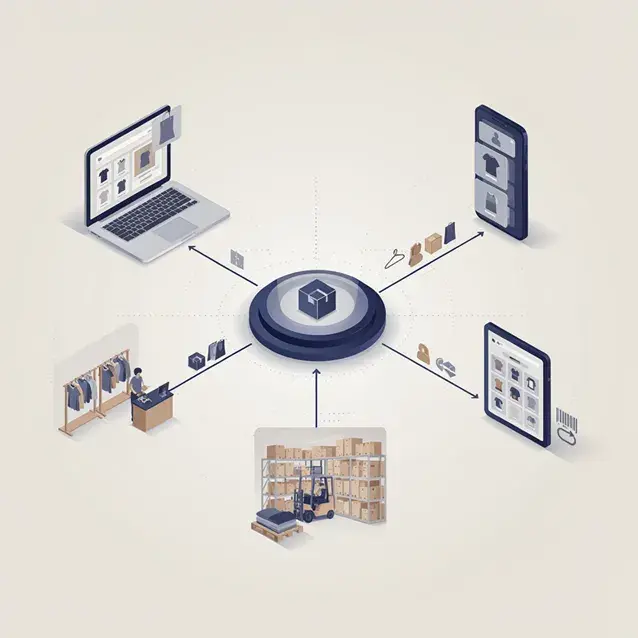
Connect your stores, website, marketplaces, and warehouse on one platform.
What Does Cloud POS Mean in a Retail?
Cloud POS means the system's core data; inventory, transactions, customer records, pricing lives on a central server rather than on the machine at the billing counter. Every store connects to the same central record. For instance: a sale in Bengaluru deducts from the same inventory pool that the Delhi store and the Myntra listing are reading from.
The practical implication is that data coherence across locations doesn't require overnight batch syncs or manual reconciliation. What happens at store one is visible at store two in real time. This matters in retail. In fashion retail, especially, where the same SKU is selling across dozens of stores and multiple online channels simultaneously, it is the difference between a system that supports the business and one that creates more complications for it.
That said, cloud POS architecture is not uniform. How data syncs, how the system behaves when connectivity drops, and how tightly the POS connects to inventory management, ERP, and OMS varies significantly between platforms. These are some details worth examining.
The Fashion Retail POS Problem Nobody Talks About Enough
A supermarket SKU is one item. A fashion SKU is a tree.
One style of women's blazer might exist in six colours and five sizes. That's thirty combinations under one product name, each needing its own inventory count, its own reorder logic, and its own sell-through tracking. A POS that manages inventory at the SKU level rather than the variant level aggregates this into one number. That number is functionally useless for the decisions that are crucial: which size is running out, which colour has been sitting for three weeks, which combination needs a markdown before the season ends.
This is the core fashion retail POS problem, and it is worth applying as the first filter to any platform evaluation. The question isn't whether the system can bill. It's whether the system understands how fashion inventory is actually structured.
Ginesys Cloud POS vs GoFrugal vs RetailGraph vs Marg ERP POS: Cloud POS for Fashion Retail
1. Ginesys Cloud POS
Ginesys's cloud POS is built specifically for fashion and lifestyle retail, and it runs on web, mobile, and desktop. It is part of the Ginesys One suite, sharing the same data layer as the ERP, OMS, and WMS, though it's also available with its own standalone pricing for retailers who don't need the full platform.
Style-size-colour inventory is native. The matrix is the product structure, not a workaround built on custom fields. Every billing transaction deducts at the variant level, updates central inventory in real time, and contributes to the sell-through data that feeds buying and replenishment decisions. During a clearance sale, when the team needs to know which size-colour combinations are still moving and which need a deeper markdown, that data is already in the system and already current.
Multi-store management covers consistent pricing and promotions applied centrally, not pushed manually to each location. A price change, a new promotion, or a loyalty program update goes live across every store simultaneously. For a brand managing fifty outlets, this isn't a convenience. It is what prevents the kind of pricing inconsistencies that show up as customer complaints and finance reconciliation headaches.
Marketplace integration with Myntra, AJIO, Flipkart, and Amazon runs through the same inventory pool. This is what prevents the overselling that third-party connectors and batch-sync systems produce during high-volume periods.
Offline functionality keeps the POS operational when connectivity drops, so billing doesn't come to a halt during an outage. Transactions made offline sync back once the connection is restored. For stores in Tier 2 cities where internet reliability is inconsistent, this is not a minor feature. Where Ginesys Cloud POS is most relevant is for fashion brands running multiple stores, managing omnichannel inventory, and operating on a seasonal buying cycle.
Its limitations are worth naming too: it is part of the Ginesys One platform, so a brand buying Ginesys Cloud POS standalone gets less value than one that has adopted the broader suite. For a retailer that needs only billing and basic inventory at two or three stores, the platform depth is more than their requirement.
For a closer look at how Ginesys Cloud POS compares with another major cloud POS, the Ginesys Cloud POS vs Shopify POS comparison covers the omnichannel and inventory dimensions in more detail.

Ready for one system built for fashion POS?
See how Ginesys Cloud POS handles variant inventory, multi-store sync, and marketplace billing natively.
2. GoFrugal
GoFrugal is one of the more widely deployed retail platforms in India, with more than 30,000 customers across 60+ countries, spanning retail, restaurant, and distribution. That scale says something on its own: this is software built to serve many industries reasonably well, not one industry in depth.
For a general merchandise retailer or a multi-category store, GoFrugal's POS covers core billing and inventory needs comfortably, and the platform integration ecosystem is broad.
Fashion retail is where the fit gets more conditional.
Style-size-colour management is achievable, but it runs through configuration rather than being how the product structure is built, which means it needs ongoing upkeep as the catalogue grows, not a one-time setup. Seasonal planning and collection-level inventory sit outside the core POS. Marketplace connectivity is available, but it runs through integrations rather than a native, shared inventory pool, and that's typically where sync delays show up.
None of this rules GoFrugal out. For a fashion retailer with straightforward inventory, fewer stores, and no pressing need for tight omnichannel coordination, it's a credible choice. The gap widens for a brand managing complex variants across a large store network, where the configuration and integration work start compounding.
3. RetailGraph / SWIL POS
RetailGraph (rebranded as SWIL POS and SWIL ERP), from Swil Software, is a retail management software with a cloud version available. It has a wide retail customer base, particularly among smaller to mid-size businesses.
Where SWIL POS holds up well is: GST compliance, barcode management, and standard reporting, as they are all handled cleanly. For a single-store or small-chain fashion retailer that needs structured billing and basic stock control, SWIL does the job without fuss.
Where it thins out is exactly where fashion retail gets demanding. Style-size-colour isn't built in as a native variant structure; it's something the retailer works around. Marketplace and omnichannel connectivity depend on third-party middleware, so a brand selling on Myntra and AJIO alongside physical stores won't get native data coherence here without adding another integration layer. If real-time sync reliability across multiple locations is a priority, that's worth confirming directly with SWIL for your specific store count and setup rather than assuming it either way.
SWIL makes the most sense for fashion businesses in the early stages, a single store or two to three locations, where the priority is dependable billing and basic stock management rather than omnichannel coordination or variant-level analytics.
4. Marg ERP POS
Marg ERP's installed base runs deep in Indian retail and distribution, especially in pharmaceutical and FMCG, industries where inventory is usually one SKU, one number, no variants. GST billing, inventory management, and basic reporting are handled competently, as you'd expect from a mature ERP suite.
The mismatch shows the moment fashion enters the picture. Marg's inventory model is built around the flat SKU structure common in FMCG and pharmacy, not the style-size-colour matrix of apparel. Getting variant management to work means building workarounds on top of a model that wasn't designed for them, and those workarounds get harder to maintain as SKU count grows. Seasonal buying, collection-level planning, and omnichannel inventory aren't part of what the platform does natively.
Garment retailers who evaluate Marg POS are usually already using Marg for distribution or accounting and are drawn to the familiarity.
Comparing on the Dimensions That Matter for Fashion
Variant-level inventory
Ginesys Cloud POS carries style-size-colour as a native data structure. GoFrugal handles variants through configuration, which requires ongoing maintenance as SKU complexity grows. RetailGraph and Marg work around it, and those workarounds produce accuracy issues once the store counts and catalogue expands.
Real-time multi-store sync
Ginesys Cloud POS writes every transaction to a central record immediately. GoFrugal is generally reliable, but sync latency varies by deployment. RetailGraph's cloud infrastructure introduces more variability across locations. Marg is stable but designed for smaller deployments.
Marketplace and omnichannel integration
Ginesys Cloud POS connects to Myntra, AJIO, Flipkart, and Amazon through the Ginesys OMS natively, same pool, no connector in between. GoFrugal reaches marketplaces through third-party connectors. RetailGraph and Marg both need external middleware, which adds integration cost and a support gap when something breaks mid-sale.
Seasonal and buying cycle management
Ginesys Cloud POS sits inside a platform that carries seasonal planning and collection-level buying natively. None of the other platforms on this list address this at the POS level, so it either lives in the system, or it lives in a spreadsheet alongside it.
Offline resilience
All four have offline modes. Ginesys's Cloud POS local cache is well-tested in Tier 2 deployments. GoFrugal's offline mode is mature and reliable. RetailGraph and Marg vary by deployment configuration.
Reporting and analytics
Ginesys Cloud POS feeds into Ginesys InsightX for variant-level sell-through, markdown effectiveness, and store performance without manual assembly. GoFrugal covers standard retail metrics. RetailGraph and Marg produce functional reports suited to smaller, less complex operations.
Scalability
Ginesys Cloud POS is built for growing multi-store fashion retailers, with a feature set geared toward chains scaling their operations. GoFrugal scales across store counts with more configuration overhead for fashion-specific needs. RetailGraph and Marg fit earlier-stage networks.
Total Cost of Ownership: What You're Really Paying For
License price is the number that appears in the comparison spreadsheet. It is rarely the number that matters most.
The real cost of a POS platform includes the:
- configuration work required to make it fit your inventory structure
- integration cost of connecting it to marketplaces and ERPs it doesn't natively talk to
- reconciliation overhead when sync reliability isn't strong enough, and
- cost of decisions made on data that was inaccurate because the system wasn't built for the complexity of the operation.
Yes, for a fashion retailer running five stores with basic requirements, the license cost difference between platforms is a relevant comparison. For those running thirty stores, managing variant-level inventory across seasonal collections, and selling on three marketplaces alongside physical retail, the total cost calculation looks very different.
The platform that handles this natively without workarounds will almost always cost less to operate over three years than one with a lower license fee and a higher overhead of manual work.

Want fewer systems and more control?
See how Ginesys Retail ERP unifies inventory, POS, and omnichannel operations on one platform.
A Buyer's Checklist for Fashion Retail POS
Before signing anything, these are the questions worth putting to every POS platform provider:
- Does the system manage inventory at the style-size-colour level natively, without custom fields or workarounds?
- Can pricing and promotions be applied centrally and reflected across every store in real time?
- Does marketplace inventory draw from the same pool as physical store inventory, and does the sync happen in real time?
- How does the system behave when a store loses connectivity, and how does it reconcile when it comes back online?
- Does sell-through reporting work at the variant level, or does it aggregate to the SKU?
- What does the implementation process look like for a 20+ store network, and who handles it?
The answers to these questions will quickly separate platforms built for fashion retail from those that can only accommodate it.

Still deciding between platforms?
Talk to a Ginesys expert about your store count, catalogue size, and marketplace mix.
Frequently Asked Questions (FAQs)
Is a cloud POS enough for a fashion retailer, or does it need to connect to a full ERP?
A cloud POS handles billing and basic inventory at the counter, but it can't manage buying cycles, variant replenishment, or omnichannel inventory across stores and marketplaces on its own. For any fashion brand past a handful of stores, the POS is one part of a larger stack.
What goes wrong when a fashion retailer picks a POS not built for variant inventory?
Sell-through reports aggregate to the SKU level, so the team can't see which sizes are aging or which colours need a markdown. The result is more inventory in the wrong variants at season end and less in the ones that kept selling.
Can GoFrugal or SWIL POS handle a 30-store fashion chain effectively?
GoFrugal can manage a mid-size network with configuration effort, but variant handling and omnichannel sync add overhead at that scale. RetailGraph is better suited to smaller operations where basic billing and inventory are the primary requirement.
How do you evaluate offline resilience in a cloud POS before committing?
Ask how the system handles a connectivity drop mid-transaction and request references from Tier 2 or Tier 3 deployments where connectivity is inconsistent. A demo environment never reflects what actually happens during a peak billing hour with no internet.