Multi-Store Apparel Retail: The Tech Stack for Scaling Past 50 Outlets
Published:
Last Updated:
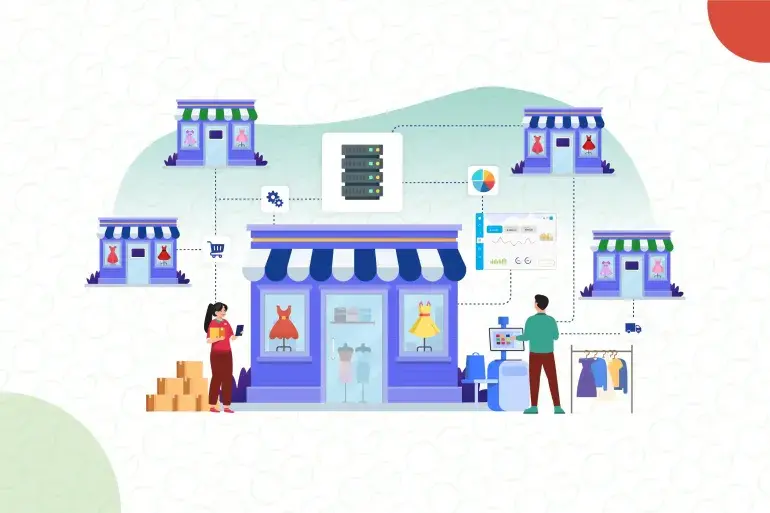
There is a version of retail growth that looks clean from the outside. More stores, more cities, more revenue. What it looks like from the inside, around store number forty, is a different story.
The spreadsheets that tracked inventory across ten stores start throwing errors nobody can explain. The WhatsApp group where store managers flag stock issues has four hundred unread messages. The weekly call between the buying team and the ops head has turned into a daily one, and it still isn't enough. Nobody made a bad decision. However, the business just grew past the system holding it together.
The jump from 20 stores to 50 is not linear. It is architectural. And the brands that navigate it well are almost always the ones that treated their technology stack as a strategic decision, not an afterthought.
Key Takeaway:
Scaling apparel retail past 50 stores requires a retail ERP with native style-colour-size variant management, a real-time-synced POS, warehouse management connected to the same inventory layer, and unified BI and CRM, all reading from one data source rather than reconciled nightly across separate systems. Below 50 stores, workarounds absorb the gaps; past it, they become structural liabilities.

Scaling beyond 50 stores? Your technology stack needs to scale too
Why 50 Stores Is the Inflection Point
Below a certain store count, workarounds are manageable. A missed replenishment here, a pricing discrepancy there, a store manager making a call on instinct because the data came in too late, none of it is ideal, but it gets absorbed. The business still functions.
Past 50 stores, the same workarounds become structural liabilities. The math is straightforward: a 1% inventory error rate per location is a small number. Spread across 50 stores and thousands of style-colour-size combinations, it compounds into stock inaccuracies that ripple into replenishment decisions, markdown strategies, and financial reporting that nobody fully trusts.
The operational surface also expands in ways that aren't obvious until you're in them. More store formats mean different operational requirements. More geographies mean different demand patterns and sometimes different pricing regions. More staff means more training, more process variation, and greater complexity in workforce management. Standardized system-driven workflows help ensure consistent store operations regardless of location or staff turnover.
The coordination model has to shift from people-dependent to system-dependent. That is not a cultural statement. It is an operational necessity. And making that shift requires a deliberate decision about the technology stack, not another incremental patch on what already exists.
POS Architecture: More Than Just Billing
A point-of-sale system at five stores is a billing tool. At fifty, it is the data collection infrastructure the rest of the business depends on.
Every transaction at every counter generates inventory data, customer data, and revenue data simultaneously. The question worth asking is not whether the POS can bill quickly, as most POS can. The question is what happens to that data after the transaction completes. Does it reach a central system in real time, or does it accumulate at the store and sync in batches overnight?
The architecture choice here has consequences that run well beyond the counter. Cloud POS with real-time central sync means every inventory deduction, every loyalty point earned, and every return processed is reflected across the network within seconds. Locally cached systems with batch updates are more resilient to connectivity issues but introduce data lag that affects every downstream decision: replenishment, inter-store transfers, and channel inventory for online orders all run on numbers that are hours behind reality.
For most multi-store fashion retailers, a hybrid architecture that leverages local caching for resilience and real-time synchronization when online provides the optimal balance of reliability and performance. Ginesys Zwing POS is built on this model, running across web, mobile, and desktop with central inventory sync, designed specifically for the operational demands of a large fashion network where both uptime and data accuracy are non-negotiable. A closer look at how the web deployment of this architecture works is covered in Web POS Explained.
The billing counter is not the end of the chain. It is the beginning of it.
What ERP Actually Needs to Do at This Scale
A retail ERP at fifty-plus stores is not a back-office system that finance uses to close the books. It is the operational spine of the business, and if it is underspecified for fashion, the consequences show up everywhere.
The non-negotiable for any fashion ERP is the style-colour-size matrix as a native data structure. This is not a feature that can be replicated through custom fields or category workarounds. The inventory matrix is the core unit of fashion inventory management, serving as the basis for every downstream decision, including purchase quantities, replenishment planning, inter-store transfers, and sell-through reporting. An ERP that treats inventory as flat SKUs forces every fashion-specific decision through a manual translation layer, and that layer is where accuracy starts to diminish.
Beyond variant management, the ERP needs to carry seasonal planning, collection-level buying structures, and markdown governance natively. A brand running two seasons, two mid-season drops, and an end-of-season clearance each year, for instance, is managing four distinct inventory planning cycles simultaneously. That cadence needs to live inside the system, not in a parallel set of planning spreadsheets that the ERP never sees.
The integration question matters as much as the features. An ERP connected to POS, warehouse, marketplace, and finance through real-time data exchange is fundamentally different from one that requires nightly reconciliation between systems. When the ERP is the single source of truth, and every connected system reads from and writes to the same data layer, decisions get made on current information. Without that, teams end up relying on outdated, conflicting, or incomplete data.

Manage variants, plan seasons, and govern markdowns - natively, in real time.
Warehouse Management and the Replenishment Problem
At fifty-plus stores, the warehouse is not a storage facility. It is a distribution decision engine, and it needs to be treated like one.
Replenishment at scale cannot run on weekly reports or buying team intuition. Demand patterns across a large network vary by location, by season, by store format, and by the specific style-colour-size combinations that move in each geography. A store in Connaught Place has a different bestseller list than a store in Indore. Both need replenishment, but they need different things, and they need them at different times.
Automated replenishment shifts the equation here. When the warehouse management system shares the same inventory layer as the POS and the ERP, replenishment triggers can fire based on actual store-level stock movements rather than projections made days ago. A size-colour combination that drops below its threshold at a high-demand location triggers a transfer request without anyone having to notice, escalate, and act on it manually.
The cost of getting replenishment wrong at scale is not abstract. Overstock in slow-moving stores ties up capital and eventually drives unnecessary markdowns. Stockouts in high-demand locations lose sales that don't come back. Both outcomes are expensive, and both are more common when replenishment is running on delayed data.
Inventory Visibility: The Architecture Question
Multi-location inventory management is not a reporting problem. It is fundamentally an architecture problem, with reporting being just one of its visible outcomes.
A retailer who can pull a stock report every morning feels like they have visibility. But a number that was accurate at 9am and is now being used to make a transfer decision at 3pm is not inventory visibility. It is historical data with a false sense of control over the present.
Real-time inventory visibility, where every sale, return, transfer, and receipt updates the same central record immediately, changes what becomes possible operationally. Inter-store transfers can be executed based on current imbalances rather than yesterday's picture. Markdown decisions during a clearance sale can target the inventory that is actually slow, not the inventory that looked slow this morning. Replenishment flows to locations based on what is happening now, not what was happening when the last report ran.
For fashion specifically, this visibility needs to go down to the variant level. Aggregate SKU data hides the information that actually drives decisions. Knowing that a particular style has 200 units across the network tells the buying team very little. Knowing that 180 of those units are size XL in stores where XL rarely sells reveals the real issue and the appropriate response, whether that's transferring stock, adjusting replenishment, or revising future purchase orders.

Gain complete visibility across every store and warehouse.
Business Intelligence That Actually Works
Most retail reporting problems are not analytics problems. They are data quality problems that surface inside the analytics layer.
When the POS, inventory system, ERP, and warehouse all update the same data record in real time, reporting becomes straightforward. Metrics such as variant-level sell-through, markdown effectiveness, store performance, and season-on-season comparisons are no longer difficult to produce. They are natural outcomes of clean, unified data. The real challenge is not analysing the data. It is getting the data right in the first place.
Ginesys InsightX provides real-time retail analytics through interactive dashboards and pre-built retail KPIs, enabling merchandising, finance, and operations teams to make faster, data-driven decisions. A merchandising head tracking sell-through during an end-of-season sale needs different information than a CFO reviewing margin by location. Both need it to come from the same underlying source, and neither should need an analyst to manually assemble it before they can act.
CRM, Loyalty, and Marketplace Integration
Customer data at enterprise scale introduces a problem that doesn't exist at ten stores: the same customer is likely transacting across multiple channels, and their experience across those channels should be consistent.
A loyalty program that works correctly across fifty stores, a D2C website, and Myntra requires a unified customer record from day one. Points earned in-store should be redeemable online. Purchase history from every channel should inform the tier calculation. When customer data is fragmented by channel, the loyalty program becomes a source of friction rather than retention.
Marketplace integration carries the same logic. Myntra, AJIO, Flipkart, Amazon, and D2C all pulling from the same central inventory pool means channel fragmentation stops being a structural risk. Overselling, pricing mismatches, and inconsistent promotions across channels are almost entirely a consequence of channels maintaining their own inventory allocations. One pool, one order management layer, one customer record: this is what Ginesys One consolidates.
Finance, Operations, and the Path to 200 Stores
Finance integration at this scale is not a nice-to-have. When POS, inventory, and ERP don't feed the same accounting layer, the reconciliation overhead at month close is significant, and the margin for error is high. Tally integration, GST compliance across multiple locations, and multi-location P&L visibility all depend on the underlying data being clean and connected.
Store operations standardisation matters more as the network grows. At fifty stores, process variation by location is a risk. At a hundred, it is a certainty if the system doesn't enforce consistency. System-driven workflows, centrally managed pricing, and standardised reporting mean the network operates to one standard regardless of which individual is managing which location.
The technology roadmap should support expansion from 50 to 200 stores without requiring major system changes. Retailers should be able to add new stores, warehouses, channels, and brands while continuing to operate on a unified platform. Scalability in retail technology is not a server capacity question. It is whether the system can absorb new stores, new channels, and new warehouse locations without requiring a new integration project at each stage. That is the difference between a platform built for scale and one that was extended to it.
How Ginesys Helps Multi-Store Retailers Scale
Ginesys has been empowering Indian fashion and lifestyle retailers since 1999. Today, over 1,200 apparel and lifestyle brands, including growing multi-store retail chains, rely on the platform to scale operations across stores, warehouses, and digital channels.
As fashion retailers expand beyond 50 stores, disconnected systems limit visibility, slow decision-making, and make consistent operations increasingly difficult to maintain. Ginesys helps enterprise retailers scale with a connected retail platform that unifies store operations, inventory, warehouse management, ERP, omnichannel commerce, and retail analytics, giving every team access to the same real-time business data as the network grows. For brands at the inflection point, the question is not whether integrated infrastructure matters. It is whether to build it before the cracks appear or after. A demo will show what the platform looks like in the context of a network your size. Book a demo with Ginesys now!

See how leading fashion retailers use Ginesys to connect ERP, POS, OMS, WMS, analytics, and omnichannel operations on a single platform.
FAQs
1. What technology does a fashion retailer need before expanding past 50 stores?
The foundation is a retail ERP with native fashion variant management, connected to a real-time POS and warehouse management system on a unified retail platform. Without this, inventory accuracy degrades as the network grows, and the reconciliation overhead required to compensate for disconnected systems scales faster than the business does.
2. How is retail ERP different from POS software for a multi-store chain?
POS software handles transactions at the counter. A retail ERP manages the entire operational backbone: buying, inventory planning, warehouse operations, finance, and reporting. At 50+ stores, both are necessary, and the quality of their integration determines how accurately the business can act on what is actually happening across the network.
3. How does real-time inventory visibility affect replenishment and sell-through at scale?
Replenishment decisions made on current data trigger faster and more accurately than those made on batch reports. Stock imbalances between locations get corrected earlier, before they require a markdown to resolve. Sell-through improves because inventory is in the right location at the right time rather than concentrated in stores where it isn't moving.
4. What does it cost to integrate POS, ERP, and WMS for a large fashion retail chain?
The cost varies significantly by platform, store count, and integration complexity. The more useful calculation is the total cost of not integrating: manual reconciliation hours, inventory errors, missed replenishment, and the markdown pressure that follows from stock being in the wrong place. Most retailers who have made this comparison find the integration cost straightforward to justify.
5. How long does it take to implement enterprise retail software across 50+ stores?
Implementation timelines vary depending on the number of stores, existing systems, data migration, and integration requirements. Most enterprise retailers adopt a phased rollout approach to minimize disruption and ensure a smooth transition across the network.
6. Can one platform handle stores, warehouses, and marketplaces for a large fashion brand?
Yes, and consolidating these on one platform is precisely what removes the data reconciliation overhead that grows with every additional system in the stack. Ginesys One covers stores, warehouse operations, marketplace integrations, and D2C on a unified retail platform with a single source of truth for inventory and operations.
7. At what store count should a fashion retailer move off spreadsheets and standalone systems?
Most fashion retailers start hitting structural limits with spreadsheets and disconnected systems between 30 and 50 stores, when a small per-location error rate compounds across enough locations and SKU variants to make manual reconciliation unreliable. The signal isn't a fixed number; it's when workarounds that used to be manageable (a missed replenishment, a pricing discrepancy) start happening daily rather than occasionally.