Multichannel Retail vs Omnichannel Retail: Understanding the Shift in Modern Commerce
Published:
Last Updated:
The retail industry has undergone a massive transformation over the past decade, driven by digital adoption, evolving consumer expectations, and the rapid expansion of online and offline commerce channels. Today, customers interact with brands across multiple touchpoints physical stores, websites, mobile apps, marketplaces, and even social media platforms. As a result, the need for retailers to adapt and thrive in this interconnected environment has become more critical than ever.
One of the most effective ways for retailers to scale and remain competitive is by adopting advanced retail strategies such as multichannel and omnichannel retailing. While both approaches involve selling through multiple platforms, they differ significantly in execution, integration, and most importantly, the customer experience they deliver.
Despite their growing relevance, many retailers still confuse multichannel and omnichannel strategies, often using the terms interchangeably. However, the distinction between the two is crucial, as it directly impacts operational efficiency, customer satisfaction, and long-term business growth.
The primary difference between multichannel and omnichannel retail lies in the quality and consistency of the customer experience. While multichannel focuses on presence across multiple platforms, omnichannel emphasizes integration and seamless interaction across those platforms.
This article aims to provide a clear understanding of the differences between multichannel and omnichannel retail formats, while also incorporating modern retail realities and the role of integrated technology ecosystems in enabling these strategies.
What Is a Multichannel Retail Format and How Does It Operate?
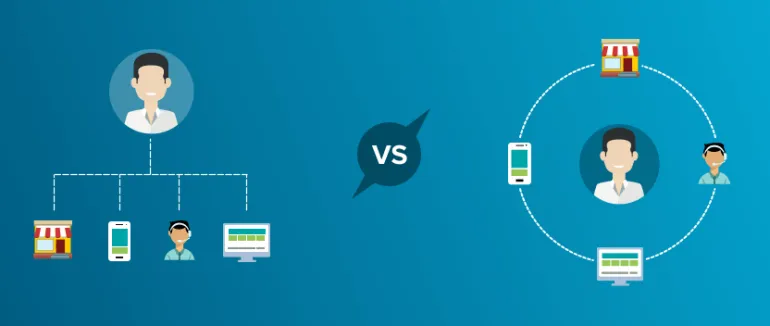
A multichannel retail format operates by establishing individual, separate sales pipelines across various offline and online platforms. Because these storefronts function as independent data silos, information like inventory counts and customer loyalty balances are not shared across touchpoints.
Traditionally, a multichannel retail format includes both physical stores and online platforms such as websites or mobile applications. Retailers adopting this approach aim to increase their reach by being present wherever their customers are. At first glance, this seems like a logical and effective strategy, as it allows businesses to tap into multiple revenue streams.
However, in a multichannel setup, each channel typically operates independently. The physical store, e-commerce website, and mobile app function as separate entities with minimal interaction between them. While they may share branding and product catalogs, their backend systems such as inventory, order management, and customer data are often disconnected.
For instance, the inventory available in brick-and-mortar stores is usually separate from the inventory allocated to online channels. This means that even if a product is available in a nearby store, an online customer may not be able to access it. Similarly, customers who purchase products online are often required to return or exchange them through the same channel.
This lack of integration creates friction in the customer journey. Customers are forced to interact with each channel separately, leading to inconsistencies in experience such as pricing differences, mismatched inventory visibility, and disconnected loyalty programs.
Operationally, multichannel retail increases complexity. Retailers often maintain separate inventory pools, manage different order flows, and reconcile data manually across systems. This results in inefficiencies such as overstocking in one channel and stockouts in another ultimately impacting profitability and customer satisfaction.
While multichannel retail was a necessary step in the evolution of commerce, it is no longer sufficient in today's customer-centric landscape. It provides reach, but not cohesion.

Eliminate disconnected systems and gain complete visibility across your retail operations.
What Is an Omnichannel Retail Format and What Architecture Does It Require?
An omnichannel retail format is a customer-centric model where all physical and digital sales touchpoints are natively interconnected in real time. This approach requires a unified data architecture that unifies checkout terminals, digital e-commerce marketplaces, and backend logistics.
Today's customers expect convenience, speed, and flexibility. They want the ability to browse online, purchase via mobile, pick up in-store, and return through any channel. Omnichannel retail makes this possible by synchronizing data, processes, and systems across all touchpoints.
In an omnichannel setup, inventory is unified, customer data is centralized, and order management is streamlined. This enables features such as:
- Buy Online, Pick Up In Store (BOPIS)
- Endless aisle (ordering from another store or warehouse)
- Ship-from-store fulfillment
- Cross-channel returns and exchanges
- Unified loyalty programs and promotions
For example, a customer may discover a product on social media, explore it on a website, and purchase it via a mobile app. They may choose to collect it from a nearby store or have it delivered. If needed, they can return or exchange the product at any location. The entire journey feels connected and effortless.
This level of integration not only enhances customer satisfaction but also improves operational efficiency. Retailers can optimize inventory usage, reduce delivery times, and increase conversion rates.
What Are the Key Differences Between Multichannel and Omnichannel Retail?
The key structural differences between multichannel and omnichannel retail rest on customer journey unity, real-time data synchronization, shared inventory pools, and flexible cross-channel order fulfillment.
- Customer Experience: Multichannel offers fragmented experiences, while omnichannel ensures a unified journey.
- Data Integration: Multichannel operates in silos, whereas omnichannel relies on real-time data synchronization.
- Inventory Management: Multichannel maintains separate inventory pools, while omnichannel uses a shared inventory system.
- Order Fulfillment: Multichannel restricts fulfillment to specific channels, whereas omnichannel allows flexible fulfillment options.
- Customer Engagement: Omnichannel enables personalized experiences through unified customer data.

Create seamless customer journeys across stores, web stores, and marketplaces.
How Does Ginesys One Enable True Omnichannel Retail Execution?
Ginesys One enables true omnichannel retail execution by combining enterprise resource planning (ERP), point-of-sale (POS) systems, and distributed order management (OMS) into one cloud-scalable platform. This setup establishes a single source of truth across all retail nodes.
Moving from a fragmented multichannel format to an integrated omnichannel framework requires a robust technological foundation. Ginesys One unifies your data stream through comprehensive retail features:
1. Unified Data Across Channels
Ginesys One centralizes inventory, orders, and customer data, ensuring a single source of truth across online and offline operations.
2. Seamless Integration of ERP, POS, and OMS
The suite combines Ginesys ERP, Ginesys POS, Zwing POS, and Browntape OMS into a unified ecosystem. This integration allows real-time synchronization of inventory and orders across stores, warehouses, and marketplaces.
3. Real-Time Inventory Visibility
As soon as a sale happens on any channel, inventory is updated instantly across all systems. This prevents overselling and ensures accurate stock availability.
4. Omnichannel Capabilities Built-In
Features like BOPIS, endless aisle, and cross-channel returns are enabled through integrated systems, allowing retailers to deliver a seamless customer experience.
5. Advanced Analytics with InsightX and BI
The platform uses a data lakehouse architecture to provide real-time insights and AI-driven analytics, helping retailers make informed decisions.
6. Flexible POS Options (Desktop, Web, Mobile)
Retailers can choose between Ginesys POS (desktop) and Zwing POS (cloud/mobile), ensuring flexibility across different retail formats.
7. Simplified GST and Compliance
EaseMyGST automates tax compliance, e-invoicing, and reconciliation, reducing manual effort and ensuring accuracy.
8. Scalability for Growing Businesses
Ginesys One supports multi-store, multi-warehouse, and multi-channel operations, making it ideal for businesses of all sizes.
9. Reduced Total Cost of Ownership (TCO)
By consolidating multiple systems into one platform, Ginesys One reduces vendor dependency, maintenance costs, and operational complexity.
Enable real-time order routing and inventory synchronization across every sales channel.
Why Must Modern Retailers Upgrade from a Multichannel Model to an Omnichannel Strategy?
The shift from multichannel to omnichannel is no longer optional it is essential for survival in today's competitive retail landscape.
Customers no longer think in terms of channels. They expect brands to provide a seamless experience regardless of how they interact. Retailers who fail to meet these expectations risk losing customers to competitors who offer better convenience and integration.
Omnichannel retail enables:
- Higher customer satisfaction and loyalty
- Improved inventory utilization
- Faster order fulfillment
- Increased sales and conversion rates
- Better decision-making through real-time data
With the right technology partner, retailers can make this transition smoothly and unlock new growth opportunities.
Bring POS, ERP, and order management together on a single retail platform.
Conclusion
The difference between multichannel and omnichannel retail lies in integration and customer experience. While multichannel retail expands reach, it falls short in delivering the seamless experience that modern consumers demand.
Omnichannel retail, powered by integrated platforms like Ginesys One, enables businesses to connect all touchpoints and provide a consistent, frictionless journey for customers.
In today's digital-first world, adopting an omnichannel strategy is not just about staying competitive it is about building a future-ready retail business that can adapt, scale, and thrive.
Transform your retail operations and build a highly scalable technology foundation today.
FAQs
1. What is multichannel retail?
Multichannel retail is a commercial model where a business sells products through several independent channels (such as physical stores, websites, and marketplaces) that operate without centralized data integration.
2. What is omnichannel retail?
Omnichannel retail is a unified commercial model that natively integrates all online and offline sales channels to provide a synchronized, continuous customer experience across all buyer touchpoints.
3. Why is an omnichannel strategy better than a multichannel approach?
An omnichannel strategy is better because it eliminates data silos, provides real-time global inventory visibility, automates multi-channel order fulfillment, and tracks unified customer history to enhance brand loyalty.
4. How does Ginesys One support omnichannel retail businesses?
Ginesys One supports businesses by linking point-of-sale systems, e-commerce orders, enterprise logistics, automated tax compliance, and cloud analytics under a single, integrated retail technology stack.
5. Can a business manage multi-channel inventory simultaneously using Ginesys software?
Yes, Ginesys software centralizes your inventory tracking, meaning a sales transaction on an online marketplace or at an in-store checkout terminal instantly updates stock counts across all locations.
6. What point-of-sale options are included within the Ginesys One suite?
The suite provides enterprise-grade desktop clients tailored for high-volume store environments (Ginesys POS) along with browser-agnostic cloud and mobile applications (Zwing POS) for agile on-floor billing.