How Multi-Store Retailers are Using Centralised OMS to Optimise Localised Fulfilment
Published:
Last Updated:
Retailers today manage far more than a single storefront. They operate networks of physical stores, warehouses, distribution hubs, e-commerce sites, and marketplace channels, all while customers expect smooth, consistent experiences across every touchpoint. Whether a shopper is browsing in-store, ordering online, or picking up locally, speed and accuracy are table stakes.
The challenge? Traditional systems and fragmented store-level processes weren’t built for this scale. They struggle to keep inventory synchronized in real time, causing fragmented stock visibility, manual errors, inefficient routing, and slower fulfilment, issues that intensify during peak seasons or promotions.
Centralized Order Management Systems (OMS) are changing that. These platforms unify orders, inventory, fulfilment, and returns under one roof, enabling retailers to route orders intelligently and optimize local fulfilment.
What is Centralised Order Management and Why is it the Backbone of Seamless Retail
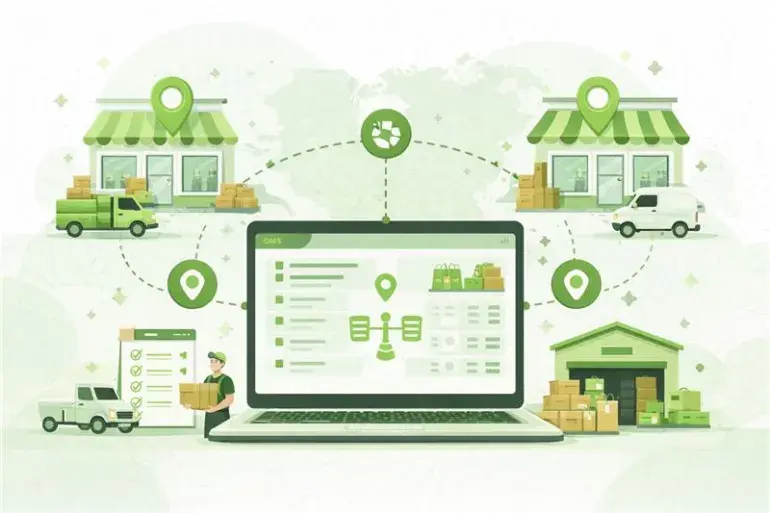
A centralised OMS is the central nervous system of omnichannel retail operations that enables multi-store retailers to scale without multiplying complexity. Instead of orders being processed independently in each sales channel or store, a centralised OMS collects all orders from online stores, marketplaces, and physical POS systems into a single platform.
Centralisation Brings Three Key Operational Benefits
- Unified inventory and order view: Retailers gain visibility into every order’s journey, from placement to dispatch, across all fulfilment nodes.
- Reduced errors and reconciliation issues: Manual data entry and fragmented systems are common error sources. Centralised OMS automates these workflows, removing much of the manual effort and inconsistencies.
- Simplified promotions, pricing, and invoicing: With a single source of truth, retailers can manage pricing, discounts, and promotions consistently across all channels and stores. This protects margins and improves customer clarity.
Centralize orders, stock, and fulfilment across all stores and online channels with real-time sync and automated order routing.
How Does Centralised OMS Enable Localised Inventory Allocation and Smarter Fulfilment Routing
One of the core advantages of a centralised OMS is real-time inventory synchronisation. Instead of each store or warehouse maintaining its own discrete stock ledger, the OMS tracks inventory across all locations: physical stores, main warehouses, third-party logistics centers, and even drop-ship vendors. Every sale, return, or transfer is reflected instantly across the system.
Smart Routing for Maximum Efficiency
A centralised OMS can make intelligent decisions about where an order should be fulfilled from, by considering factors such as:
- Stock availability by SKU in each location
- Proximity of fulfilment location to the customer
- Delivery timelines and cost implications
- Operational constraints like peak workloads at individual stores
Using these rules, the OMS can route orders to the best fulfilment node, whether that’s a nearby store (for faster delivery), a central warehouse (for bulk or overflow stock), or even a drop-ship partner.
This high-precision routing:
- Reduces delivery costs by minimising transit distance
- Speeds up delivery times, delighting customers
- Optimizes stock distribution, avoiding overstock in some stores and stockouts in others
These capabilities also support modern omnichannel fulfilment models like click-and-collect, in-store pickup, or ship-from-store.
How Does Centralised OMS Speed Up Fulfilment While Reducing Costs
Centralised order routing and workflow automation transform fulfilment from a repetitive manual task into an optimized, efficient process.
Faster Fulfilment Through Standardised Workflow
With a centralised OMS:
- Orders are captured instantly into a single queue
- Picking, packing, and dispatch actions are standardised
- Automated logic assigns fulfilment tasks without human intervention
This leads to dramatically shorter lead times, from order capture to pickup and delivery, significantly enhancing customer satisfaction.
Cost Optimisations That Matter
When an OMS routes orders based on both proximity and capacity, shippers can minimize transit distances and reduce last-mile delivery costs.
This has a direct impact on:
- Shipping expenses
- Warehouse labour costs
- Inventory holding costs
- Carbon emissions from inefficient routing
In markets where delivery speed is a differentiator, these operational savings can translate directly into higher margins, giving even regional or independent brands the ability to compete with larger e-commerce players.

Get unified stock visibility that prevents mismatches and protects revenue even during peak demand.
How Does Real-Time Inventory Visibility Manage Stockouts and Overstocking
One of the most pervasive challenges in multi-store retail is inventory disparities, situations where stock appears available in one system but is already sold elsewhere. A centralised OMS manages this by updating inventory levels in real time across all fulfilment points.
Consistent visibility enables:
- Accurate stock availability for customer orders
- Reduced overselling
- Automated replenishment trigger points
- Transfer recommendations between stores to avoid local shortfalls
This ensures customers don’t encounter ghost inventory. The system also automatically adjusts available quantities when items are returned, cancelled, or transferred, ensuring the inventory picture is always current.
With accurate stock data, retailers can forecast demand more reliably, plan replenishment cycles efficiently, and improve cash flow by minimising obsolete or dead stock.
How do Centralised OMS Platforms Simplify Returns and Reverse Logistics
Return management, especially across many storefronts, can be one of the most complex aspects of retail operations. Customers expect flexible return options: return at any store, refund by original payment method, or exchange at a preferred nearby outlet.
Without centralised management, returns can cause lost inventory miscounts, inconsistent return policies across locations, and complications from manual reconciliation.
A centralised OMS standardises returns by:
- Routing return orders to the nearest or most appropriate store/warehouse
- Updating inventory automatically upon receipt
- Triggering refunds or exchanges according to pre-defined business rules
This streamlines reverse logistics, removes mismatches in stock levels, and reduces manual labour. This is especially important for retailers managing thousands of SKUs or fluctuating seasonal demand.

How Does a Centralised OMS Enable Data-Driven Forecasting and Analytics
At scale, decentralized systems generate heaps of data, but that data is often fragmented, making it hard to extract meaningful insights.
A centralised OMS consolidates operational data from all channels and locations, enabling actionable analytics on:
- Sales trends by region or store
- SKU velocity and profitability
- Seasonal demand patterns
- Inventory turnover and slow-moving items
- Performance of fulfilment locations
Retailers can leverage these insights to adjust reorder quantities, plan promotional strategies, refine fulfilment rules (e.g., minimum buffer stock per region), and optimise store staffing and labour at picking stations.
How Can Multi-Store Retailers Enable Centralised OMS with Ginesys One
Ginesys offers a unified retail technology suite that embeds a robust OMS within a larger omnichannel ecosystem, seamlessly integrating with ERP, POS, marketplaces, webstores, and logistics partners.
It empowers multi-store retailers with:
- Real-time inventory synchronization across stores and channels: Ensuring inventory levels update instantly across stores, warehouses, marketplaces, and e-commerce platforms.
- Smart fulfilment routing: With intelligent order allocation logic, orders are automatically routed to the best fulfilment location based on stock levels, proximity to the customer, delivery timelines, and cost.
- Seamless omnichannel integration: Ginesys OMS (Browntape) integrates with POS and ERP systems, marketplaces like Amazon, Flipkart and Ajio webstore platforms like Shopify, and logistics partners for end-to-end order and inventory connectivity.
- Advanced omnichannel fulfilment options: Support for click-and-collect, ship-from-store, endless aisle, and buffer stock strategies ensures flexible fulfilment models that meet modern consumer expectations.
- Returns and reverse logistics: Automated return workflows update inventory and customer records while maintaining transparency and audit trails across stores.

Connect Amazon, Flipkart, Myntra, Ajio, JioMart and more; handle orders, inventory, and analytics centrally.
What Does a Centralized OMS Mean for Customer Experience, Efficiency, and Growth
At its core, adopting a centralized OMS transforms how multi-store retailers compete in a world where customer expectations are only expected to rise.
- Enhanced Customer Experience: Retailers can rightly promise faster delivery, accurate stock information, flexible fulfilment options, and hassle-free returns. This translates into higher satisfaction, stronger loyalty, and more repeat purchases within omnichannel environments.
- Operational Efficiency & Cost Savings: Because processes are automated and data flows are unified, manual workload drops significantly, errors diminish, inventory costs fall, and cash flow improves. Retailers can also scale easily; adding new stores or channels doesn’t create proportional complexity when backed by a centralized OMS.
- Strategic Advantage in Competitive Markets: A centralized OMS enables retailers to respond to demand fluctuations, compete with ecommerce giants on fulfilment speed, and enter new markets confidently.

Enable Ship-From-Store, Click & Collect, and Endless Aisle to meet modern consumer expectations and shorten delivery timelines.
Multi-store retail isn’t just about having multiple locations. It’s about orchestrating a dispersed network into a cohesive, fulfilment-focused machine that serves customers with speed, accuracy, and convenience. A centralized OMS is the cornerstone of this transformation. By consolidating orders, enabling real-time inventory visibility, routing fulfilment intelligently, streamlining returns, and powering advanced analytics, it creates a strategic advantage that multi-store retailers aspire to have.
Turn your multi-store network into a coordinated fulfilment engine and deliver faster, more reliable experiences at scale: explore how Ginesys One’s centralised OMS can unify inventory, orders, fulfilment, and analytics to accelerate multi-store retail growth.
FAQs
How does a centralised OMS determine the optimal fulfilment node for an order?
It uses real-time data on stock availability, customer location, delivery SLAs, and business-defined rules or AI-driven logic to automatically select the most efficient store, warehouse, or 3PL partner for fulfilment.
Can a centralized OMS integrate with external systems such as ERP, WMS, and accounting software?
Yes. A robust OMS supports API-driven or pre-built integrations with ERP, warehouse management systems (WMS), courier services, marketplaces, and financial systems to ensure seamless data exchange and process automation.
What technical mechanisms ensure inventory accuracy across channels in a centralised OMS?
Real-time, bidirectional synchronisation updates stock levels instantly when sales, returns, or transfers occur, preventing overselling and ensuring all connected channels and systems reflect the current state.
How does automated routing logic reduce operational load during high-volume periods like sales or promotions?
By applying predefined rules (e.g., nearest fulfilment location, inventory thresholds, SLA priorities) to dynamically assign orders without manual intervention, it accelerates processing and maintains accuracy even under heavy order volumes.