Packing Video Software vs CCTV: Why Order-Linked Proof Wins Marketplace Claims
Published:
Last Updated:
Marketplaces don't give sellers much time to respond to a claim. A claim comes in, wrong item, missing product, damaged goods, and the seller has a window to submit proof of what was actually packed. Miss that window, or fail to produce convincing proof within it, and the claim is typically settled against the seller by default.
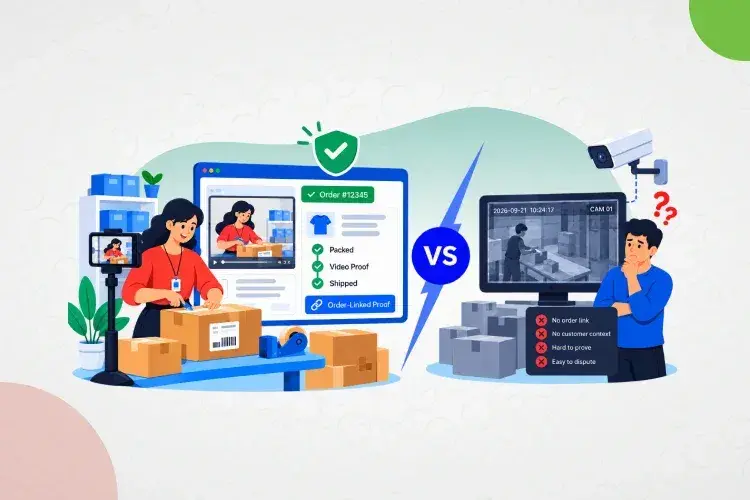
Most sellers find out too late that CCTV isn't really proof; it's just footage. Somebody has to sit and scrub through hours of warehouse video, guess roughly when the order was packed, and hope the right camera was pointed the right way at that moment. Order-linked video skips all of that. The footage is already tied to the order number, so there's nothing to search for when a claim shows up.
That's really the whole difference: having to go looking for evidence versus already having it filed under the order. It's the reason some claims get closed in a couple of days and others drag on or get decided against the seller simply because the proof didn't surface in time.
This piece breaks down why that difference exists, and what separates a system that gives you proof on demand from one that just gives you a recording to search through. Let's discuss.
Key Takeaway:
Order-linked packing video ties evidence directly to the Order ID, SKU and AWB at the point of capture, while CCTV requires a manual search by camera and timestamp, which is why order-linked evidence resolves marketplace claims faster and keeps working predictably as order volume grows.
Why Isn't CCTV Footage Enough to Prove What You Packed?
A fashion brand dispatches 400 orders on a Tuesday. A marketplace claim arrives Thursday for Order ID 7842. The customer says the wrong size was sent. The brand knows the correct SKU left the warehouse. The warehouse manager is confident. But confidence doesn't settle a claim. Evidence does.
Now comes the CCTV search. Which camera covers that packing station? What time was that order processed? Is the footage from that camera stored locally or on a server? Is the resolution clear enough to read a label? Forty-five minutes later, someone is squinting at grainy footage, trying to confirm a size label that may or may not be readable. The claim deadline is two days away.
This is not a unique case. It is what happens every time a warehouse relies on continuous surveillance as its evidence strategy.
CCTV Watches the Warehouse, So Who's Watching the Order?
CCTV is designed for security and general monitoring. It records what happens in a space. It was never designed to answer the question “what was inside Order 7842 when it left this building?”
Order-level packing video software works differently. Evidence is captured per order, per item, and linked directly to the Order ID, SKU, and AWB at the point of capture. There are a few solutions that operate on this logic; every item packed generates a tagged, timestamped record that can be retrieved by order number rather than by camera angle and timestamp.
The operational shift this represents is significant. Instead of recording everything and retrieving something useful, the system captures only what matters and makes it easy to find immediately when a dispute is raised.
How Does Order-Linked Evidence Turn Footage into Claim-Ready Proof?
The mechanics of order-linked evidence are worth understanding clearly.
When a picker scans a barcode at the packing station, the system captures images or video of that item at that moment and tags the file with the Order ID, SKU, AWB number, and timestamp. Multiple views, labels, product, packages, are captured against the same order record. The evidence file isn't sitting in a camera storage system waiting to be located. It is indexed against a specific order and retrievable in seconds.
For marketplace claims, this changes the entire response workflow. A claim arrives. The ops team searches by Order ID. The tagged footage and images from dispatch appear immediately. The evidence is already structured in the format a marketplace dispute team expects. Submission happens on the same day the claim arrives, not two days later after a footage hunt.
Stop searching through footage for proof that should be ready by order.

Build a more structured evidence workflow with connected order, inventory and fulfilment data.
Why Does Manual Evidence Collection Fall Apart at Scale?
At 50 orders a day, CCTV-based evidence retrieval is inconvenient. At 500, it becomes a productivity problem. At 2,000 during a peak sale period, it actually breaks.
The issue isn't just the time spent locating footage. It is the compounding of that time across every claim, across every warehouse, with every claim having a deadline that the marketplace enforces regardless of the seller's internal bottlenecks. Adding more cameras doesn't fix this. More cameras mean more footage to search through, not faster retrieval of the right evidence.
Automated order-level capture removes the retrieval problem entirely. For instance, the evidence for Order 7842 is not somewhere in Tuesday's footage. It is filed under Order 7842. That distinction is the difference between a scalable claims process and one that consumes warehouse staff time proportionally as volume grows.
What's the Real ROI of Order-Linked Packing Evidence?
The return on investment here runs across three categories.
Revenue recovered is the most direct. Marketplace claims that can be substantiated with clear, order-linked evidence are resolved faster and more often in the seller's favour. Claims that go unsubstantiated within the deadline are typically written off. For a brand processing 100 claims a month at an average order value of ₹800, the revenue at stake is big.
Labour saved is the second category. If each CCTV-based evidence search takes 45 minutes, 100 claims a month costs 75 hours of warehouse staff time. Automated retrieval reduces that to minutes per claim. That time goes back into other conducive operations.
Errors prevented is the third. The discipline of capturing per-order evidence at the packing station also functions as a quality check. Items that were mispicked are more likely to be caught before dispatch when the packing step includes a verification capture. Prevention is cheaper than dispute resolution.

See what a structured, order-linked evidence process could be worth for your team.
What Should You Actually Look for in Packing Video Software?
For brands evaluating dedicated packing evidence solutions, the core requirements are:
- Per-order, per-item image and video capture at the packing station.
- Barcode, Order ID, SKU, and AWB tagging applied automatically at the point of capture.
- Timestamped, searchable storage with retrieval by order number rather than by camera and time.
- Fast evidence export in formats that marketplaces accept for dispute submission.
- Integration with OMS and WMS, so evidence capture sits inside the existing fulfilment workflow rather than running as a separate tool.
- Scalability across multiple packing stations and warehouse locations as volume grows.
How to Strengthen Order Fulfilment with Ginesys?
Ginesys brings ecommerce order management, inventory and warehouse operations together to help retailers manage fulfilment across marketplaces and webstores. Ginesys OMS supports order and inventory management, order allocation, picking, packing and shipping, while Ginesys WMS supports warehouse fulfilment operations.
Ginesys WMS supports barcode-based warehouse processes, including scanning picked items to confirm them against the pick list before fulfilment. This gives warehouse teams a way to validate that the items picked for an order actually match the pick list, before they move through packing and shipping.
With OMS and WMS working together, Ginesys helps retailers maintain a connected view of ecommerce orders, inventory and warehouse fulfilment. Because every pick, pack and shipment is logged in the system, these records can also serve as a useful reference if a business wants to trace what happened with a specific order later on.

to explore how Ginesys connects ecommerce order management, inventory and warehouse fulfilment.
Frequently Asked Questions (FAQs)
What is the difference between CCTV and order-linked packing video evidence?
CCTV records continuous footage of a space and requires manual search by timestamp and camera angle to find relevant footage for a specific order. Order-linked evidence captures images and video per order, tagged to the Order ID and SKU, and is retrievable by order number in seconds.
Why do marketplace claims require order-level evidence rather than general warehouse footage?
Marketplace dispute teams need evidence tied to a specific order, item, and dispatch event. General CCTV footage requires the seller to identify the relevant clip, confirm the SKU is visible, and produce it within a deadline, a process that frequently fails on one of those three requirements.
Does Ginesys offer packing-side video evidence capture?
Ginesys's video evidence capability is currently on the return side with plans to enhance it for forward shipments too, through the Video Management System within OMS's Return QC module. It captures return-side evidence per order and SKU rather than packing-side dispatch evidence.
What does the Ginesys return video evidence module actually capture?
When a returned order is scanned, the module captures video across multiple views, label, package, front view, tagged to the Order ID. It runs on phone, desktop, and local CCTV setups and connects the footage to the broader order and inventory data in the Ginesys OMS.
How does automated evidence retrieval affect warehouse productivity?
Manual CCTV searches for a single claim can take 30 to 60 minutes per incident. Automated, order-linked retrieval reduces this to under a minute. For warehouses processing dozens of claims monthly, the productivity return is significant and compounds as order volume grows.