Omnichannel Retail Software for D2C Fashion: Single View of Inventory and Customer
Published:
Last Updated:
Growth creates a challenge that most D2C fashion brands don't see coming. Every new sales channel solves one problem while quietly creating another.
A Shopify store helps launch the brand. Myntra and AJIO expand reach. A warehouse improves fulfilment. A physical store strengthens customer experience. Each decision supports growth. But every new channel also introduces another source of inventory, customer, and order data. Before long, the same business is operating across multiple systems that were never designed to work together.
By the time inventory no longer matches across channels or a loyal customer appears as three different people in three different systems, the issue isn't operational anymore. It's the lack of a connected foundation for omnichannel retail.
Key Takeaway:
Omnichannel retail for D2C fashion brands only works when inventory, order management, and customer data run on one shared system instead of being reconciled after the fact across separate platforms; a real-time single view of inventory and customers is what prevents overselling, delayed fulfilment, and fragmented loyalty as a brand adds marketplaces, stores, and warehouses.

Still managing inventory across disconnected systems? Unify your D2C website, marketplaces, stores, and warehouses on Ginesys One.
How Fragmentation Actually Happens
Fragmentation doesn't announce itself with a single failure. It accumulates. A customer earns loyalty points on Myntra and tries to redeem them in-store. She can't, because the two systems don't share a customer record. She doesn't complain. She just stops considering herself a loyal customer.
Every Monday, the operations team spends hours combining inventory reports from the website, marketplaces, and stores just to understand what's actually in stock. By the time the report is ready, parts of it are already out of date. A Shopify order goes through for a jacket that sold at the store two hours earlier because the website hadn't updated yet. The cancellation email goes out. The customer posts about it.
None of these are dramatic failures. Together, they are the cost of a backend that was never designed as one thing. And at a certain channel count and revenue level, that cost stops being manageable overhead and starts being a ceiling on growth.
What Omnichannel Actually Requires
The word gets used loosely. Selling on five channels is not omnichannel. It is multichannel, and the distinction is not semantic.
Multichannel means the brand is present in multiple places. Omnichannel means those places are running on the same underlying data. The customer experience that omnichannel promises, such as consistent pricing, promotions, returns, and loyalty across every channel, is only possible when the systems underneath are unified.
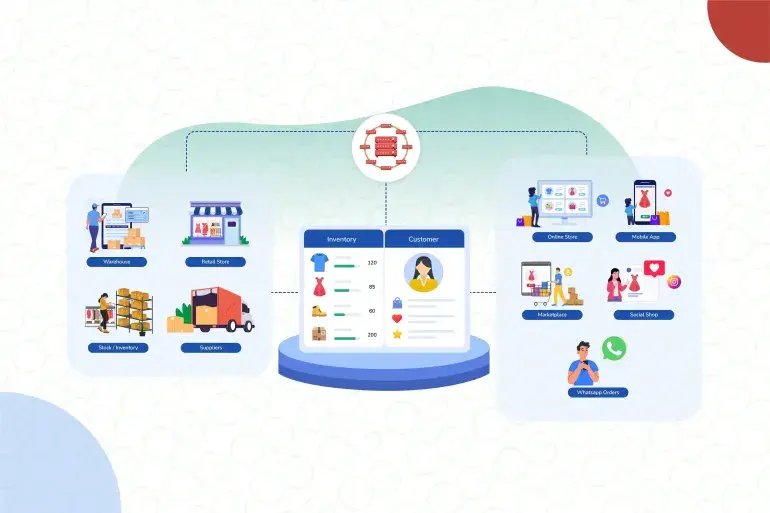
Three things have to be single for this to work. Inventory: one count, visible to every channel simultaneously, updated the moment a unit moves anywhere. Customer data: one profile carrying every transaction, regardless of platform. Order management: one routing layer deciding where each order fulfils from, across every touchpoint. Everything else, including fulfilment, loyalty, returns and customer experience, depends on getting these three foundations right.
Omnichannel isn't about adding more channels. It's about making every channel behave like part of the same business.
Why a Single Inventory View Changes Everything
Overselling is almost always a data latency problem, not a demand problem.
When channels maintain their own inventory counts and sync on a schedule, a sync window opens. During that window, which might be thirty minutes or even two hours, two channels can both sell the last available unit. One order fulfils. The other gets cancelled. During a sale weekend or a new collection drop, when order velocity is highest, that window generates a disproportionate number of cancellations relative to normal trading.
A shared inventory pool closes the window. When a unit sells on AJIO, it is deducted from the central count in seconds and immediately unavailable on the website, on Amazon, and in the store system. The channels don't sync with each other. They all read from the same number.
Preventing overselling is only one benefit. A unified inventory view also helps teams make better replenishment, allocation, and markdown decisions because everyone is working from the same real-time inventory picture. Warehouse stock, store stock, and in-transit units tracked in one place give the operations team a real picture of what is available when they are making transfer decisions, planning replenishment, or deciding which inventory needs a markdown before the season closes.

One inventory pool, zero guesswork - track every store, warehouse, marketplace, and D2C channel in real time.
Order Management: Routing That Reflects What's Real
Customers don't think about fulfilment. They simply expect orders to arrive quickly and accurately. An OMS makes that possible by routing every order to the most appropriate fulfilment location based on inventory availability, proximity, and delivery commitments. Optimal means different things depending on the order: sometimes it is the warehouse closest to the customer, sometimes it is a store with available stock thirty kilometers from the delivery address.
Ship-from-store is a capability that only works if store inventory is part of the same pool as warehouse inventory. When it isn't, the routing logic has no visibility into what the store is holding. It can't make an intelligent decision, so it defaults to the warehouse even when the store would have been faster and cheaper.
Click-and-collect introduces a similar dependency. A customer orders online and expects to pick up in-store. When the online order and the store inventory are running on different update cycles, the store doesn't know the order is coming until someone manually checks. Staff have to verify separately. The confirmation is delayed. Customers who experience this friction once rarely try it again.
Returns are where the operational cost compounds most directly. A jacket returned at a store from an online order needs to hit the central inventory count the same day, not after a nightly batch sync. Every day that return sits unprocessed is a day the unit is unavailable for resale. During a season that is still running, that is a direct cost, not a reconciliation issue.
One routing layer for every order, online or in-store - powered by real inventory availability, not guesswork.
Customer Data: What the Brand Loses When It's Split
A customer may discover the brand on Myntra, place another order through the brand's website a few months later, and then visit a physical store during a seasonal sale. Although it's the same person interacting with the same brand, each purchase creates a separate customer record because the systems aren't connected. Instead of building one complete customer profile, the brand ends up with fragmented purchase history and loyalty data.
As a result, the marketing team may send a first-purchase welcome offer to someone who has already been buying from the brand for months.
Fragmented customer data doesn't just make loyalty programs inaccurate. It makes personalisation structurally impossible. Re-engagement campaigns target active customers as lapsed ones. Tier calculations undercount real spend. Product recommendations draw from one channel's history and miss everything the customer did everywhere else.
Unified customer profiles change what the marketing team can actually do. Segmentation becomes based on real behaviour across every touchpoint. Loyalty reflects genuine spend. A customer who has bought twelve times across channels gets treated like a customer who has bought twelve times, not like three different people who each bought four times.
Returns as Intelligence, Not Just Logistics
Returns are often viewed as an operational process, but they also provide valuable merchandising insights. Which styles generate the highest return rates? Which sizes are consistently exchanged? Which locations experience the highest return volumes? When returns data sits alongside sales and inventory data, buying teams can make better assortment and replenishment decisions for future collections.
Business Analytics That Support Growth
Omnichannel retail generates large volumes of operational data, but data alone doesn't improve performance. Teams need visibility into inventory movement, channel performance, customer behaviour, fulfilment efficiency, and returns. With InsightX by Ginesys, retailers can access real-time retail analytics through interactive dashboards and pre-built retail KPIs, helping merchandising, operations, and leadership teams make faster, data-driven decisions.
When every team works from the same trusted data, improving customer experience becomes a measurable business outcome rather than guesswork.
What to Actually Evaluate When Choosing Omnichannel Software
Real-time inventory sync is the non-negotiable. Not near-real-time, not frequent batch updates. Every other capability in an omnichannel platform is built on whether inventory accuracy holds at volume, during peak periods, across every channel simultaneously.
Native marketplace integrations matter more than a long list of connector partnerships. A third-party connector between an OMS and Myntra introduces another potential source of latency, and when it fails during a high-volume sale event, the support conversation becomes a blame-transfer exercise between vendors. Native integrations remove that layer and the accountability gap that comes with it.
Implementation sequencing is worth getting right. Start with inventory unification before building out channel-specific features. The brands that reverse this and launch channel features before the inventory layer is stable pay for it during their next peak period, when every channel-specific problem is amplified by the volume.
Scalability should be part of the evaluation too. As D2C fashion brands grow, they often add new marketplaces, warehouses, fulfilment locations, and physical stores. The right omnichannel platform should support that growth without requiring separate integrations, fragmented inventory pools, or major changes to existing workflows or disruption to day-to-day operations.
How Ginesys Powers Omnichannel Growth
D2C brands rarely struggle because they lack sales channels. They struggle because every new channel introduces more operational complexity. Ginesys One helps simplify that complexity by connecting OMS, WMS, ERP, POS, marketplaces, and customer data on a unified retail platform. This gives fashion brands a single view of inventory, orders, and customers as they scale across online and offline channels.
For brands at that inflection point, a demo is the most direct way to see how the unified backend handles the specific channels and complexity of the current operation.

Create one seamless shopping experience across every channel - ERP, OMS, WMS, POS, and marketplaces, unified.
FAQs
1. When does a D2C fashion brand need omnichannel retail software?
Most D2C fashion brands start feeling the need for omnichannel software when they expand beyond a single sales channel. Adding marketplaces, physical stores, or multiple fulfilment locations often introduces inventory mismatches, fragmented customer data, and operational inefficiencies that are difficult to manage through separate systems.
2. Can omnichannel software reduce cancelled orders and overselling?
Yes. When every sales channel draws inventory from the same real-time stock pool, the risk of selling the same unit twice is significantly reduced. This improves inventory accuracy while reducing order cancellations and customer dissatisfaction.
3. Can D2C brands continue using Shopify, Myntra, or Amazon after implementing omnichannel software?
Yes. A modern omnichannel platform should integrate with existing sales channels rather than replace them. Ginesys connects websites, marketplaces, stores, and warehouses so brands can continue selling across their preferred channels while managing operations from one platform.
4. Why is a unified customer profile important for D2C fashion brands?
A unified customer profile brings together purchases made across websites, marketplaces, and stores. This allows brands to deliver consistent loyalty benefits, more relevant product recommendations, and better customer service while building a complete view of customer behaviour.
5. What should D2C brands look for when choosing omnichannel retail software?
Beyond integrations, brands should evaluate whether the platform provides real-time inventory visibility, unified customer profiles, centralized order management, native marketplace connectivity, scalability, and analytics that support future growth.
6. Can omnichannel software scale as my D2C fashion brand grows?
The right platform should support expansion across new marketplaces, warehouses, fulfilment centres, and physical stores without requiring disconnected systems or major operational changes. Scalability is just as important as current functionality when evaluating omnichannel software.
7. How does omnichannel software improve the customer experience?
Connected inventory, unified customer profiles, and centralized order management allow brands to offer consistent pricing, loyalty, fulfilment, returns, and service across every touchpoint. Customers experience one brand, regardless of where they choose to shop.