Choosing the Right ERP for Retail: Industry-Focused vs General-Purpose Solutions
Published:
Last Updated:
An Enterprise Resource Planning (ERP) software solution has evolved from being a back-office support system to becoming the digital backbone of modern businesses. In today's highly competitive and data-driven environment, ERP is not just about managing processes it is about enabling agility, visibility, and informed decision-making across the organization. Regardless of the industry, businesses rely on ERP systems to centrally manage operations through a unified database that connects departments, streamlines workflows, and ensures real-time data availability.
For the retail industry, the importance of ERP is even more pronounced. Retail is inherently dynamic, with constant fluctuations in demand, evolving consumer preferences, seasonal trends, and the increasing complexity of omnichannel operations. Retailers today are expected to deliver seamless customer experiences across physical stores, e-commerce platforms, and marketplaces, all while maintaining operational efficiency and profitability.
An ERP solution in a retail organization plays a crucial role in ensuring the seamless functioning of the business. Retailers must continuously monitor inventory across multiple locations, manage procurement cycles efficiently, handle pricing and promotions dynamically, process sales transactions in real time, maintain accurate financial records, and track customer and employee data. Beyond these fundamentals, modern retail also demands integration with e-commerce platforms, warehouse management systems, logistics providers, and customer engagement tools.
Given these evolving requirements, the question that arises is whether a general-purpose ERP solution is sufficient for retail businesses, or whether an industry-focused ERP solution offers a better fit. While general ERP systems provide a broad framework that can be adapted to multiple industries, retail-focused ERP solutions are designed with the unique challenges and workflows of the retail sector in mind.
Undoubtedly, a retail-focused ERP solution proves to be a more effective choice for retailers. In this article, we will explore the factors that give industry-specific ERP solutions a significant advantage over general-purpose ERP software, while also incorporating the realities of modern retail and the capabilities expected from contemporary ERP ecosystems.
Why Do Generic ERP Solutions Fall Short in Customization and Industry Alignment?
Generic ERP solutions fall short because they lack built-in support for retail-specific matrix attributes like product size, color, style variants, and promotional markdown logic. To adapt a generic system to retail workflows, brands must invest in heavy, fragile custom software development.
When a retailer opts for a general-purpose ERP solution, the system typically provides a foundational structure designed to cater to multiple industries such as manufacturing, services, and distribution. While this versatility may seem beneficial initially, it often creates challenges when applied to retail operations.
Retail businesses deal with intricate processes such as multi-store inventory management, SKU-level tracking, product variants (size, color, style), promotional pricing, seasonal collections, returns and exchanges, and customer loyalty programs. A general ERP system does not inherently support these specialized requirements. As a result, extensive customization is required to tailor the system to retail workflows.
For example, a retailer sourcing products from multiple vendors needs a robust vendor and merchandise management system. This includes tracking vendor details, product categories, variant attributes, batch information, warranty details, and taxation rules. In a general ERP system, these capabilities must be developed or heavily modified, increasing complexity and implementation effort.
Additionally, modern retail operates in an omnichannel environment, where businesses must integrate online and offline sales seamlessly. General ERP systems often lack built-in support for such integrations, requiring additional tools or development efforts.
On the other hand, industry-focused ERP solutions are designed specifically for retail. They come equipped with pre-configured modules for merchandise planning, assortment management, replenishment, and real-time inventory tracking. This significantly reduces the need for customization and ensures that the system aligns with business operations from the beginning.
Furthermore, modern retail ERP ecosystems often include integrated components such as POS systems, order management, analytics, and compliance tools. These modules are designed to work together seamlessly, providing a unified platform for managing all aspects of the business.
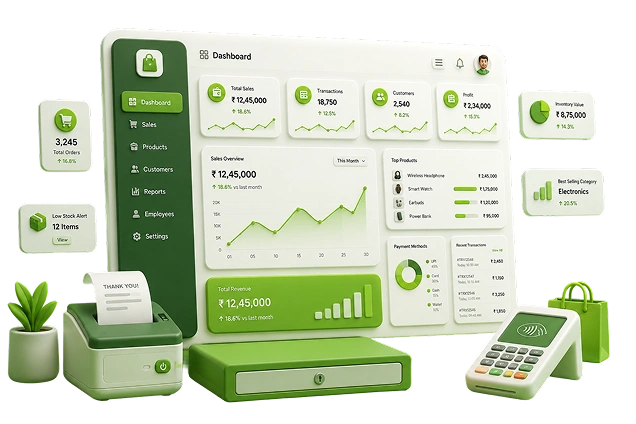
Automate your frontline billing counters and sync sales data instantly with your backend ledgers.
How Do Sourcing Software Customizations Affect the Total Cost of Ownership?
Sourcing software customizations increase the Total Cost of Ownership (TCO) of generic ERPs by introducing ongoing developer fees, integration overheads, and system maintenance friction. These hidden implementation expenses quickly wipe out any initial software licensing discounts.
General ERP solutions typically require significant customization to meet retail-specific requirements. This involves hiring skilled professionals, investing in development resources, and allocating time for testing and implementation. Each customization adds to the overall cost, and ongoing maintenance further increases expenses.
Integration costs also play a significant role. Retail businesses often use multiple systems for POS, e-commerce, logistics, and customer engagement. Integrating these systems with a general ERP can be complex and expensive.
Training costs must also be considered. Customized systems often have unique workflows that require extensive training for employees.
In contrast, retail-focused ERP solutions may involve a higher upfront investment but offer better long-term value. Since these systems are designed specifically for retail, they require minimal customization and come with built-in functionalities.
Modern ERP ecosystems also reduce dependency on multiple vendors by offering integrated tools under a single suite, thereby lowering operational complexity and cost.
Centralize your multi-location stock tracking and eliminate manual bookkeeping errors.
Why Do Retail-Specific ERP Systems Offer Faster Implementation Timelines?
Retail-specific ERP systems offer faster implementation timelines by replacing custom software coding with pre-configured retail parameters and native omnichannel workflows. This structural layout shifts the deployment strategy from engineering code to adjusting operational toggles.
Because retail-focused platforms arrive equipped with pre-built modules for merchandise allocation, automated inventory tiering, and supplier logistics, businesses can launch their new infrastructure in a fraction of the time.
General-purpose ERP systems typically require a longer implementation timeline due to the extensive customization needed. Integration with third-party systems and employee training further delay deployment. Cloud-based deployment further accelerates implementation, enabling retailers to go live quickly and start realizing value sooner. Faster adoption also ensures quicker ROI and improved operational efficiency.
Why Do Multi-Store Retail Chains Require a Specialized Solution Like Ginesys?
Multi-store retail chains require a specialized platform like Ginesys to manage decentralized storefront checkouts while maintaining strict, centralized control over inventory, pricing, and tax regulations.
As retail businesses scale, managing operations across multiple stores, warehouses, and sales channels becomes increasingly complex. This is where solutions like the Ginesys ERP, part of the broader Ginesys One ecosystem, provide significant advantages.
It is important to note that Ginesys is not designed for single-store retailers or very small businesses. Instead, it is purpose-built for growing retail chains, wholesalers, and enterprises that operate across multiple locations and require centralized control with decentralized execution.
Some of the key benefits include:
1. Centralized Control with Multi-Location Visibility
Ginesys ERP enables businesses to manage multiple stores, warehouses, and distribution centers from a single platform. Retailers get real-time visibility into stock levels, sales performance, and inventory movement across all locations, enabling better decision-making.
2. Seamless Integration with POS Systems
Through solutions like Ginesys POS and Zwing POS, retailers can ensure smooth billing operations across stores. These POS systems are tightly integrated with the ERP, allowing real-time data synchronization between front-end sales and backend operations.
3. Omnichannel Order Management
With integrated order management capabilities such as Browntape (OMS), retailers can manage orders from multiple online marketplaces and their own e-commerce platforms. This ensures efficient order processing, inventory synchronization, and faster fulfillment.
4. Advanced Inventory and Warehouse Management
Ginesys ERP offers robust inventory control mechanisms, including batch tracking, stock transfers, replenishment planning, and warehouse optimization. This is especially critical for retailers handling large volumes and diverse product assortments.
5. GST and Compliance Management
With tools like EasemyGST, businesses can manage taxation and compliance seamlessly. Automated GST calculations and reporting reduce manual effort and ensure accuracy.
6. Business Intelligence and Data-Driven Decisions
Ginesys BI and InsightX provide powerful analytics capabilities, enabling retailers to gain insights into sales trends, customer behavior, and operational performance. This helps in making informed strategic decisions.
7. Scalability for Growing Retail Chains
As businesses expand, Ginesys ERP scales effortlessly to accommodate new stores, channels, and product lines. This makes it a future-ready solution for retailers aiming for long-term growth.
8. Unified Ecosystem Approach
The Ginesys One suite integrates ERP, POS, OMS, analytics, and compliance tools into a single ecosystem. This eliminates data silos and ensures smooth information flow across the organization.

Connect your retail counters to digital e-commerce web stores and online marketplaces seamlessly.
How Do Modern Retail Dynamics Drive the Need for Integrated Analytics?
Modern retail dynamics drive the need for integrated analytics by demanding that businesses process vast streams of cross-channel consumer data to adjust pricing and stock levels instantly.
The retail landscape has evolved significantly, driven by digital transformation and changing consumer expectations. Businesses must now manage multiple sales channels, including physical stores, e-commerce platforms, and online marketplaces.
This shift has increased the demand for integrated ERP platforms that go beyond traditional functionalities. Modern retail ERP solutions now offer omnichannel integration, advanced analytics, automated compliance, and enhanced customer engagement capabilities.
An integrated platform ensures that all components work together seamlessly, providing a unified view of the business and enabling better decision-making.

Unify stores, warehouses, and online channels through a connected retail ecosystem.
Conclusion
Selecting the right ERP solution is a strategic decision that can significantly impact the success of a retail business. While general-purpose ERP systems offer flexibility, they often fall short in addressing the complexities of retail operations.
Retail-focused ERP solutions provide a tailored approach with faster implementation, lower long-term costs, and better alignment with business needs. For multi-store retailers and wholesalers, solutions like Ginesys ERP offer a comprehensive ecosystem that supports scalability, efficiency, and growth.
In today's competitive retail environment, investing in the right ERP is not just about managing operations it is about building a strong foundation for future success.
Transform your retail operations and build a future-ready technology foundation.
Frequently Asked Questions (FAQs)
1. What is the main difference between a retail-specific ERP and a generic ERP?
A retail-specific ERP features built-in architecture engineered for storefront operations, such as matrix SKU configurations, real-time multi-store inventory syncing, and POS connectivity. A generic ERP requires extensive custom coding to support these features.
2. Is a generic or general-purpose ERP ever suitable for a retail business?
Generic ERP systems can manage basic bookkeeping for small, single-location retail setups. However, as a business scales into multi-channel sales, marketplace listings, and multiple warehouses, a specialized retail ERP becomes essential.
3. Why is a specialized ERP critical for multi-store retail chains?
A specialized ERP provides centralized operational control, giving executive teams real-time visibility over multi-warehouse stock levels, unified pricing rules, and cross-store returns from a single cloud dashboard.
4. Is Ginesys ERP suitable for independent single-store retailers?
No, Ginesys ERP is designed specifically for multi-store retail chains, large-scale wholesalers, and expanding corporate retail franchises that require advanced warehouse logistics and multi-channel synchronization.
5. How does a specialized retail ERP support omnichannel retail?
It unifies frontline point-of-sale terminals with digital e-commerce storefronts and third-party marketplace platforms, ensuring that all orders, product catalog descriptions, and stock tallies stay perfectly synced.
6. What are the long-term financial benefits of a retail-focused ERP software?
A retail-focused ERP software delivers a lower Total Cost of Ownership (TCO) by eliminating ongoing developer fees for custom adjustments, shortening implementation delays, and reducing stockout losses via smart replenishment.
7. How long does it take to implement a specialized retail ERP solution?
While timelines depend on enterprise size, retail-specific ERP solutions deploy much faster than generic options because they rely on out-of-the-box configuration toggles rather than long software development cycles.
8. Can a specialized retail ERP improve the shopper checkout experience?
Yes. By providing accurate stock visibility, automated loyalty calculation data, and frictionless omnichannel fulfillment options like buy online, pick up in store (BOPIS), it significantly upgrades consumer satisfaction.