Market Basket Analysis: How Billing Software Improves Product Placement
Published:
Last Updated:
Market Basket Analysis helps retailers identify products customers frequently buy together to improve merchandising and store layouts. Most retail merchandising decisions are still made the old-fashioned way. Category managers rely on gut feel, seasonal calendars, and vendor negotiation outcomes. Yet according to McKinsey & Company, data-informed assortment decisions can deliver a 2 to 5 percent sales increase and a 5 to 10 percent gross margin uplift. The gap between retailers who capture this lift and those who do not is rarely about data availability. It is about interpretation.
Basket analysis examines what customers really buy together, not what category logic says they should. The best place to run it is not a standalone analytics platform; it is the billing software already sitting at the core of every store operation.
This blog is for retail operations and merchandising decision-makers who want to understand how transaction-level intelligence from POS and ERP systems can reshape product placement strategy and improve revenue per square foot.
How Market Basket Analysis Works Inside Retail Billing Software
Market basket analysis is a pattern detection exercise built on association rule mining. It uses the Apriori algorithm to surface product combinations that co-appear in transactions above a statistically significant frequency.
The three operating metrics are support (how often a combination appears), confidence (how reliably product B appears when product A is purchased), and lift (whether the co-purchase is meaningful or coincidental given each product's individual popularity).
A well-configured retail point of sales application captures item combinations at SKU level, purchase timestamps, basket totals, and transaction sequences, generating this intelligence with every completed sale. When centralized across stores and formats, associations emerge that no category manager would spot manually.
AI-enabled billing systems go further, applying machine learning to surface non-obvious relationships across store clusters and customer segments. The prerequisite is clean infrastructure — SKU-level barcode integration, standardized product tagging, and a unified billing data layer.
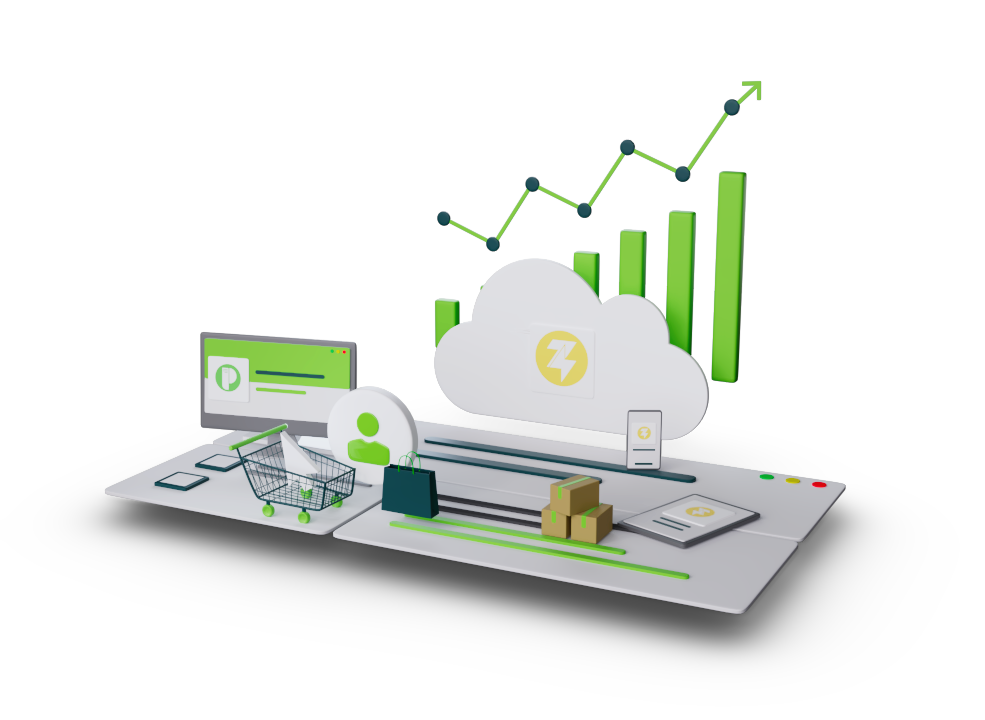
Streamline basket analysis with unified POS and ERP data across every retail touchpoint.
What Retailers Can Learn from Customer Buying Patterns
Basket data decodes customer intent beyond individual product preferences. A customer buying whole grain bread, low-fat dairy, and fresh vegetables signals a health-conscious, meal-planning orientation. A customer buying energy drinks, instant noodles, and a phone charger signals a completely different shopping occasion. Both are merchandising opportunities, but they are only visible through transaction-level data.
A critical concept here is the anchor product, a SKU whose presence in a basket reliably predicts several additional purchases in the same transaction. Anchors are often category entry points rather than your highest-margin lines. Identifying them by store format and customer segment is one of the highest-leverage applications of basket analysis.
Patterns also shift by location, day part, and season. Billing data that is time-stamped and geo-tagged allows retailers to build segmented models and make locally relevant placement decisions, rather than applying a single national planogram across a heterogeneous store network.

How In-Store Product Placement Influences Basket Size and Customer Flow
Physical retail operates on a simple principle: proximity drives purchase. A study of over 3,000 shoppers found that 82 percent of purchase decisions are made inside the store and 62 percent of shoppers make an impulse buy on any given trip. Store layout is one of the most powerful revenue levers a retailer controls, and consistently one of the most under-optimized.
High-traffic zones, end caps, and checkout counters capture disproportionate dwell time and drive unplanned discovery. The question is not whether these zones matter, but which products belong in them for your specific customer base. Basket analysis answers that with evidence rather than assumption.
Aisle adjacency decisions benefit particularly here. Traditional floor plans separate categories by department logic, while basket data frequently reveals that cross-departmental purchase journeys are more common than assumed. Bridging certain zones with connector products increases basket depth without a full planogram rebuild.

Turn billing transactions into smarter merchandising decisions with real-time retail analytics.
Smart Product Placement and Cross-Merchandising Strategies
The most immediate application is cross-merchandising, co-locating products customers frequently buy together regardless of parent category. Snacks adjacent to beverages. Charging accessories near electronics. Grooming kits grouped with skincare. The placement logic shifts from category hierarchy to purchase affinity.
Promotional displays become more effective when informed by basket data. A retailer running an end cap for a breakfast cereal brand can increase display lift by co-featuring the top products that transactionally co-appear with that SKU, turning a single-product promotion into a basket-building event.
Market Basket analysis also enables disciplined A/B testing. A layout intervention in one store cluster, measured against a control cluster using pre/post billing data, produces quantifiable outcomes — average basket size, attachment rate, and units per transaction — that compound into a durable feedback loop.
Using Billing Data to Improve Cross-Selling and Upselling
Real-time recommendation logic embedded in the POS can prompt billing staff with relevant add-on suggestions based on what is already in the basket. This mirrors the approach that, according to McKinsey data, drives approximately 35 percent of Amazon's purchases, applied here to a physical retail context grounded in actual store-level history.
Customer purchase history accessible through an integrated billing and CRM system enables personalized promotion design. A loyalty member who buys formal shirts but rarely adds belts is a visible, actionable upsell opportunity. A customer regularly buying premium pet food but never grooming products is a well-qualified cross-sell candidate.
Basket data surfaces these segments at scale. Improving cross-sell accuracy reduces dependence on discounting, since the right product reaching the right customer at the right moment drives purchase without requiring a markdown.

Improve cross-selling opportunities using centralized SKU-level transaction visibility across stores.
The Role of Real-Time Analytics and Retail Segments
Weekly reports have a structural problem. By the time data is reviewed, the store floor has moved on. Real-time dashboards connected to POS and ERP give teams live visibility into basket trends and campaign performance. An underperforming display can be corrected within hours.
Predictive analytics adds a forward-looking layer. By combining historical basket patterns with seasonal signals, AI-enabled platforms can recommend placement adjustments ahead of demand spikes. McKinsey confirms that automated, store-specific planogramming is already deployed by leading European grocers and is becoming a competitive differentiator.
How this plays out differs meaningfully by segment. Grocery retailers use basket analysis for meal occasion groupings and checkout impulse placement. Nielsen's research across 50,000 FMCG purchases confirms that in-store purchase intent varies significantly by category type.
Fashion retailers surface accessory pairing logic by style tier and season to increase units per transaction. Pharmacy and wellness retailers build groupings around health outcomes rather than pharmaceutical classification. Specialty retailers use billing insights to build localized merchandising for niche audiences without per-location custom research.
Common Implementation Challenges
Fragmented billing infrastructure is the most common failure point. Retailers running multiple POS systems without centralized consolidation end up with siloed data that is analytically unreliable. Cross-store pattern detection requires a unified layer.
Inconsistent SKU tagging compounds this. The same product coded differently across stores turns basket analysis into noise. Manual reporting adds latency that kills utility. The answer in every case is a centralized retail technology platform that unifies POS, ERP, inventory, and analytics on shared infrastructure. Without it, basket analysis remains a periodic exercise rather than an operational capability.
Connect inventory, billing, and merchandising data to optimize in-store product placement faster.
How Ginesys Turns Billing Data into Merchandising Intelligence
Ginesys is a unified retail technology platform for Indian and South Asian retail enterprises, integrating POS billing, retail ERP, inventory management, and omnichannel operations on a single stack.
The Ginesys POS Billing Software captures SKU-level transaction data across store formats in real time, with barcode integration and standardized taxonomy ensuring every billed transaction feeds a clean analytics foundation.
Its Retail ERP connects merchandising, inventory, and sales data so basket-informed placement decisions link directly to replenishment and assortment planning without manual reconciliation. Ginesys' Analytics and Reporting Solutions surface basket composition trends, cross-category affinities, and store-level variations, giving multi-store decision-makers the evidence base to act with confidence rather than convention.
Future Trends in Basket Analysis and Store Planning
The next generation of basket analysis is shifting from descriptive to predictive. AI models trained on multi-year transaction data can forecast which product combinations will emerge as high-affinity pairs before the trend appears in aggregate reporting.
Unified online-offline customer data is accelerating this further. In-store basket behaviour and e-commerce purchase history, connected through loyalty identifiers, produce richer association models than either channel generates independently.
Computer vision and smart shelf technology are beginning to add spatial basket data — which products customers examine before deciding and which display formats drive engagement. Combined with transaction basket analysis, this will make planogram optimization substantially more precise.
Billing software is evolving from a transaction tool into a strategic engine for customer behaviour intelligence. Retailers who build on that foundation now will hold a durable advantage as physical store productivity faces sustained pressure.
Ready to turn your billing data into a merchandising advantage? See how Ginesys helps retailers move from transaction recording to customer intelligence.
FAQs
1. What is the minimum transaction volume for Market basket analysis to produce statistically reliable results?
Reliable association rules require a minimum support threshold of 1 to 2 percent across at least 10,000 transactions per analysis period. Below this, outputs should be treated as directional rather than conclusive.
2. How does Market basket analysis differ from sales velocity analysis for placement decisions?
Sales velocity identifies top-performing individual SKUs; basket analysis identifies co-purchase relationships that drive multi-item transactions. Basket-informed placement produces higher basket size uplift because it optimizes for cross-category discovery, not just individual product prominence.
3. Can Market basket analysis support planogram optimization in stores with fewer than 500 active SKUs?
Yes. Smaller SKU environments often produce cleaner associations because the signal-to-noise ratio is lower. Basket data will still reveal which products function as anchors and which are consistent add-ons, directly informing adjacency and cross-merchandising decisions.
4. How should retailers handle promotional period data to avoid skewing baseline association models?
Promotional transactions should be tagged and analysed separately or filtered from baseline models. Promotion-driven co-purchases reflect incentive response rather than natural affinity and mixing them with everyday data inflates confidence scores for promoted pairs.