Challenges in Retail Industry and How to Solve Them
Published:
Last Updated:
Running a retail business has never been easy. While the industry promises scale, reach, and high customer engagement, it also presents a unique set of challenges that test business owners every single day. From managing inventory and customers to handling compliance, technology upgrades, and profitability tracking, retailers constantly walk a tightrope between growth and control.
In recent years, the complexity of retail operations has increased significantly. Customers are more informed and demanding. Sales happen across multiple channels, physical stores, marketplaces, brand websites, and social platforms. Product assortments have expanded, competition has intensified, and margins have become tighter. At the same time, retailers are expected to deliver faster service, personalized experiences, and seamless returns—all while keeping costs under control.
Despite these pressures, many retail business owners still struggle to identify what exactly is going wrong when they face operational bottlenecks. Even fewer know how to systematically resolve these issues without disrupting day-to-day operations. Often, challenges are addressed in silos, leading to short-term fixes rather than long-term solutions.
In this article, we explore four major challenges that most retailers—especially small and mid-sized businesses—commonly face. More importantly, we explain how these challenges can be effectively addressed by leveraging the right retail technology ecosystem, with a special focus on integrated ERP, POS, analytics, and cloud-based solutions like Ginesys One.
Challenge 1: Handling a Wide Range of Categories and Products
One of the most fundamental challenges in retail is managing an ever-expanding range of categories and products. As consumer preferences evolve and competition increases, retailers are compelled to broaden their assortments to stay relevant. While this strategy may drive footfall and sales, it also introduces significant operational complexity.
In a typical retail business, especially in segments such as apparel, footwear, lifestyle, electronics, or FMCG, products are not just defined by a single attribute. A single SKU can vary across:
- Size
- Color
- Style
- Pattern
- Brand
- Season
- Price range
For example, in an apparel-based retail environment, one garment design can translate into dozens of SKUs when size and color variations are taken into account. Multiply this across categories and stores, and inventory management quickly becomes overwhelming.
The Hidden Risks of Poor Inventory Visibility
Without a structured system in place, retailers often rely on spreadsheets or fragmented software tools to track inventory. This leads to several problems:
- Inaccurate stock visibility
- Overstocking of slow-moving items
- Frequent stockouts of high-demand products
- High carrying costs
- Manual errors during reconciliation
Monitoring the performance of a particular product becomes a strenuous task, involving repeated slicing and dicing of data. Decisions related to replenishment, markdowns, and assortment optimization are often delayed or based on incomplete information.
In an omnichannel setup, the challenge multiplies further. Inventory must be synchronized across physical stores, warehouses, and online channels. Any mismatch can result in overselling, cancelled orders, or poor customer experience.

Stop losing sales to stockouts explore Ginesys Inventory Management Solution.
Solution: Robust Inventory Management with Ginesys
To overcome this challenge, retailers must invest in a comprehensive inventory management software solution that is purpose-built for retail complexity.
Ginesys ERP, part of the Ginesys One suite, enables retailers to:
- Define multi-dimensional product hierarchies
- Track inventory at SKU, store, and warehouse levels
- Manage variants effortlessly
- Monitor stock movement in real time
The system allows retailers to map and monitor all categories of marketable products with precision. Inventory data is updated automatically with every sale, return, transfer, or procurement transaction, eliminating the need for manual reconciliation.
With advanced reporting and analytics through Ginesys BI and InsightX, retailers can:
- Identify fast- and slow-moving products
- Optimize assortment by store or region
- Reduce dead stock
- Improve inventory turnover
By bringing structure and visibility to inventory operations, retailers can significantly reduce errors, improve availability, and free up working capital, turning inventory from a challenge into a competitive advantage.
Challenge 2: Identifying and Retaining Loyal Customers
In retail, customer acquisition is expensive, but customer retention is profitable. Loyal customers not only purchase repeatedly but also spend more per transaction and recommend the brand to others. Despite this, many retailers struggle to identify who their loyal customers actually are.
In a busy retail environment, especially in physical stores, it is nearly impossible for staff to recognize repeat customers manually. Over time, valuable customer relationships are lost, and every visit is treated as a new transaction rather than an opportunity to deepen engagement.
Why Loyalty Is Difficult to Execute in Retail
Retailers face several obstacles when it comes to customer loyalty:
- Lack of customer identification at POS
- Disconnected systems for sales and customer data
- Inability to track purchase history across stores
- No real-time visibility into customer value
As a result, even retailers who run loyalty programs often fail to personalize offers or reward customers meaningfully. Loyalty initiatives become generic, transactional, and ineffective.
.webp)
Turn every transaction into a relationship with Ginesys Desktop & Cloud POS.
Solution: POS-Led Customer Identification and Integration
Retailers must use a POS solution that captures customer data at the point of sale and integrates seamlessly with third-party loyalty and CRM systems.
Ginesys POS enables retailers to:
- Capture customer details during billing
- Track purchase history across visits and locations
- Integrate with external loyalty program partners
Although Ginesys does not provide a native loyalty program, its strength lies in enabling smooth integration with loyalty platforms. This ensures that retailers can:
- Identify repeat customers
- Offer personalized discounts and rewards
- Maintain consistency across stores
Taking this further, retailers can upgrade to an efficient mobile POS solution like Zwing POS. With mPOS, store associates are no longer confined to billing counters. They can engage with customers directly at checkout, answer queries, and create a more personalized shopping experience.
This human interaction—supported by real-time access to customer and transaction data—plays a crucial role in building long-term loyalty.
Challenge 3: Upgrading Hardware and Software
One of the most underestimated challenges in retail is technology inertia. Retailers who have been in business for many years often hesitate to upgrade their hardware and software systems. This reluctance is usually driven by fear—fear of data loss, fear of downtime, and fear of operational disruption.
Legacy systems may appear stable on the surface, but they gradually become liabilities. They are difficult to maintain, expensive to upgrade, and incompatible with modern retail requirements such as omnichannel integration, analytics, and mobility.
The Cost of Delayed Upgradation
Retailers who delay technology upgrades often face:
- Inability to scale operations
- Poor system performance during peak periods
- Limited integration capabilities
- Higher IT maintenance costs
Moreover, synchronizing data across multiple outlets becomes increasingly difficult with outdated systems. Simple customer-centric operations—such as allowing returns at a different store—become operational nightmares.
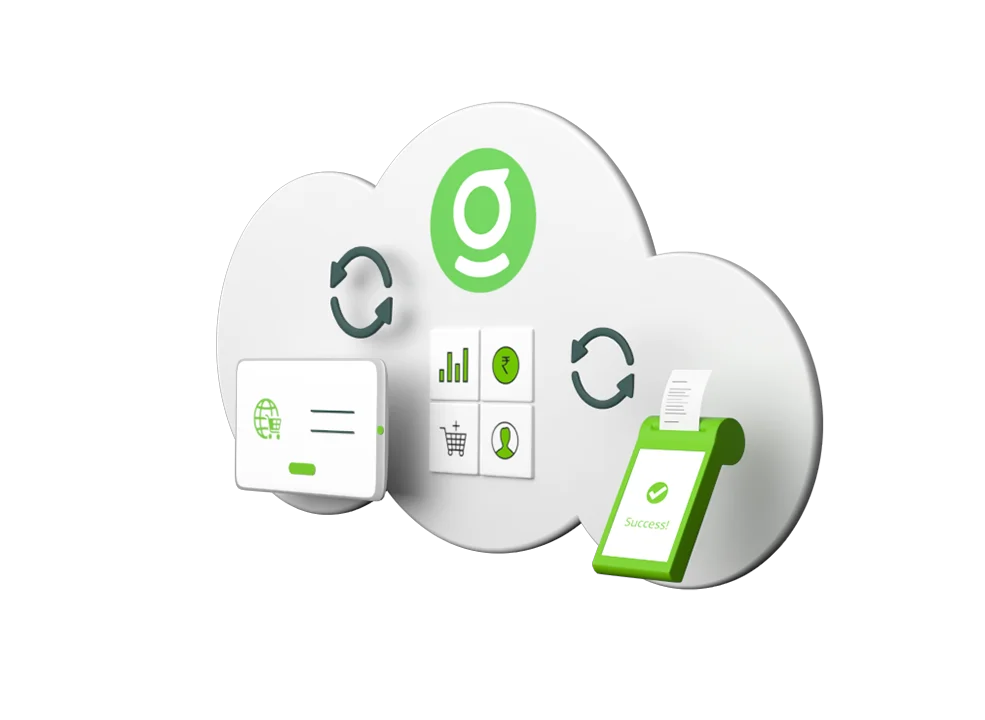
Future-proof your retail business with our secure Cloud ERP platform.
Solution: Cloud-Based ERP and POS with Ginesys
Retailers must invest in end-to-end ERP solutions hosted on cloud platforms, such as Ginesys Cloud ERP.
Cloud-based solutions offer several advantages:
- Centralized data across all stores and warehouses
- Automatic backups and disaster recovery
- Faster upgrades without manual intervention
- Reduced dependency on local IT infrastructure
With Ginesys Cloud, data synchronization across outlets becomes seamless. A customer who purchases in one city can return or exchange the product in another without friction—significantly enhancing customer experience.
Cloud deployment also ensures that retailers stay current with statutory updates, security enhancements, and feature upgrades, without the burden of complex implementation projects.
Challenge 4: Gauging ROI on Technology and Business Investments
Every investment made by a retailer—whether in new systems, additional stores, or marketing initiatives—is ultimately aimed at business growth. However, measuring the return on these investments remains a major challenge.
Retailers often lack clear visibility into:
- Store-level profitability
- Category-wise margins
- Impact of promotions and discounts
- Cost versus benefit of technology upgrades
Without accurate data, decision-making becomes reactive and subjective.

Get real-time insights into your store profitability, see how Ginesys BI works.
Solution: Analytics-Driven Performance Measurement
To gauge ROI effectively, retailers must combine accounting data with operational analytics.
With Ginesys ERP, financial transactions are automatically captured and structured. When this data is analyzed through Ginesys BI and InsightX, retailers gain deep insights into:
- Sales growth trends
- Cost structures
- Margin performance
- Store and channel profitability
These insights help business owners evaluate whether investments are delivering expected returns and where course corrections are needed.
Analytics-driven visibility transforms ROI measurement from guesswork into a structured, repeatable process—enabling smarter scaling decisions.

Ready to scale your retail operations? Book a personalized demo today.
Conclusion
Retail challenges are inevitable, but being unprepared is not. The difference between struggling retailers and successful ones lies in how effectively they leverage technology to solve operational problems.
By addressing inventory complexity, customer retention, technology upgrades, and ROI measurement through a unified platform like Ginesys One, retailers can turn challenges into growth opportunities.
In today's retail landscape, the right technology is not just a support system—it is the foundation of sustainable success.
FAQs
What are the biggest challenges faced by retailers today?
Inventory complexity, customer retention, technology upgrades, and ROI measurement are among the top challenges.
How does Ginesys help manage large product assortments?
Through structured inventory hierarchies, real-time tracking, and advanced analytics.
Does Ginesys offer loyalty programs?
Ginesys integrates with third-party loyalty platforms via its POS and ERP systems.
Is cloud ERP suitable for SME retailers?
Yes. Cloud ERP reduces IT overhead, improves scalability, and simplifies upgrades.
Can Ginesys support multi-store operations?
Yes. Ginesys One is designed for multi-store, multi-warehouse retail and wholesale businesses.